Showing posts with label books. Show all posts

Wednesday, June 10, 2015

Summer Reading: The Professor and the Madman (ch. 1-2)

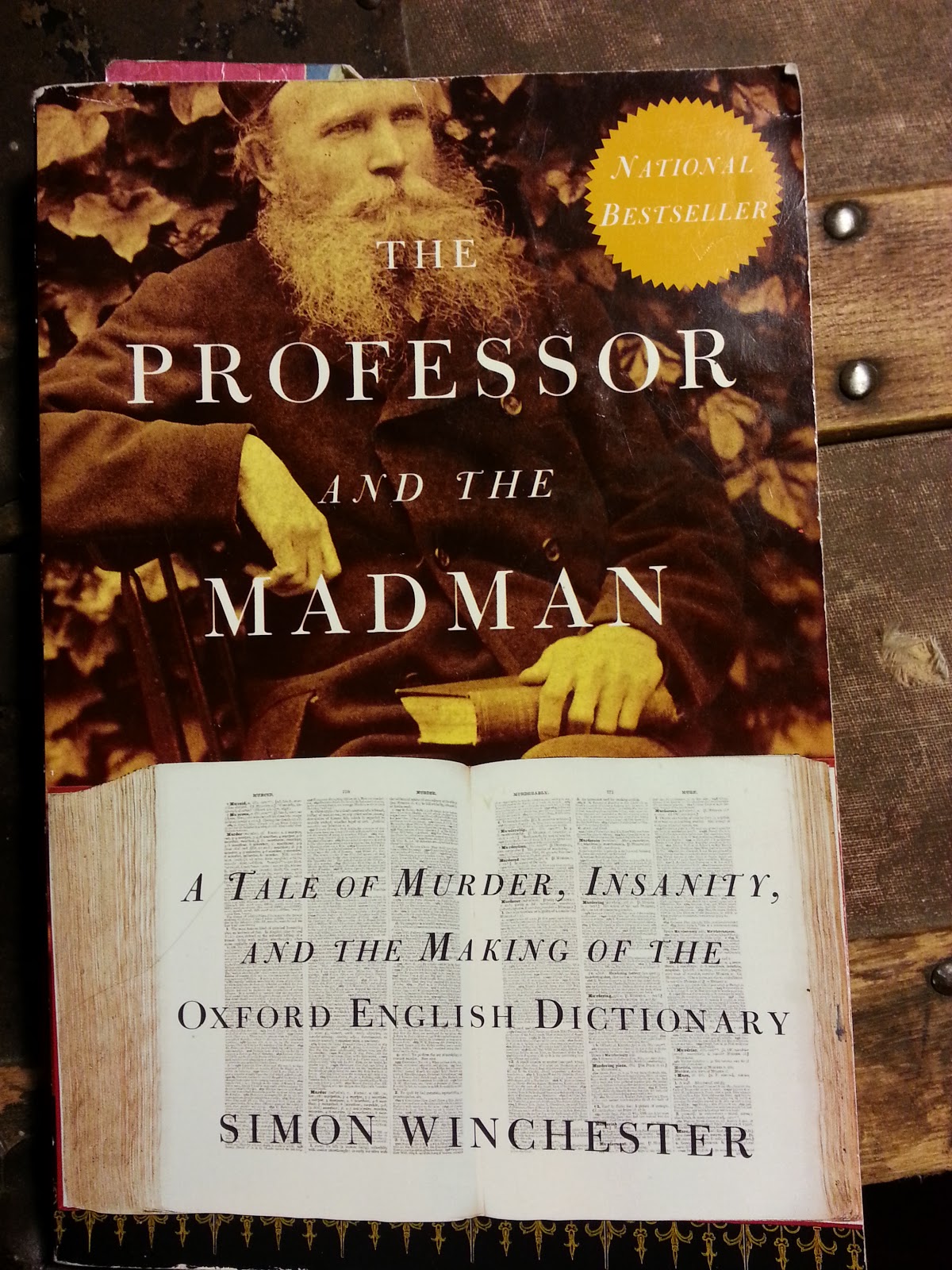
I've been volunteering in a thrift store's book section. Amazingly, I've only bought two three books (the number changed after I started this post) and brought home several free ones. One of them is The Professor and the Madman: A Tale of Murder, Insanity, and the Making of the Oxford English Dictionary by Simon Winchester. Can you guess which part of the title caught my attention? Here's a hint: I'm an English major.

I think Winchester has spent too much time reading the Oxford English Dictionary (referred to as the OED from here on out), because he uses a lot of unfamiliar words. Seriously. I've been reading on the college level since long before college, and I do as much of the assigned reading as possible. My vocabulary isn't shabby. But Winchester throws in words like "louche" and "garroting" like everyone should know them.

louche: disreputable or sordid in a rakishly appealing way

garroting: present participle of "garrote," meaning to kill someone by strangulation, typically with a wire, cord, or iron collar

I've only read two chapters so far. The first begins with an excerpt of the OED's entry for "murder." It covers the incident that landed Dr. WC Minor in an asylum for the criminally insane. The second chapter has two epigraphs, excerpted from the entries for polymath ("A person of much or varied learning; one acquainted with various subjects of study") and philology ("Love of learning and literature; the study of literature, in a wide sense, including grammar, literary criticism and interpretation, the relation of literature and written records to history, etc.; literary or classical scholarship; polite learning"). This chapter focuses on Professor James Murray's life before his work as the lead editor of the OED. Murray didn't have much of a formal education, but he loved learning... to call him a "polymath" who learned for the sake of "philology" is an understatement. He was a nerd. The book doesn't say "nerd," of course. But in today's lingo, that's the best way to describe him. He knew Latin, of course. But he varied from fluent to familiar with all the Romance languages, as well as Dutch, Flemish, German, Danish. And he was quite capable in the realm of Anglo-Saxon and Moeso-Gothic as well. All that before he got higher education. If he lived 100 years later, I bet he'd be a Tolkien fan, fluent in Elvish and all derivatives, including the tongue of Mordor.

The second chapter also paused to recount the "protagonist" definition controversy. The OED said there could be multiple protagonists. In 1926, Fowler's Modern English Usage declared that "protagonist" could only be singular, and any instance of plural was absurd. The OED settled the matter over fifty years later, confirming that protagonist can, in fact, be pluralized. That's a relief, because The Professor and the Madman has two protagonists, as the title indicates.

I'm sensing that this author is a bit of a nerd, too. I'm a little out of my depth. It's like saying, "I'm a Naruto fan!" then meeting someone who knows a dozen jutsu hand signs and all the characters' names. Except with the English language.

This isn't as enjoyable as, say, a fantasy novel. But I still like it, and I'll keep puttering through it over the next week or two.

---
P.S.: I referenced the OED in two of last year's posts. I wrote about the origins of the words "geek" and "nerd." Thought it would be appropriate to link to those here, especially since they came from the homework assignment that introduced me to the OED.

Wednesday, May 27, 2015

Summer Reading: The Wise Man's Fear

Last week, I said I should avoid reading until I finished my screenplay. But when I can borrow library eBooks without leaving my couch, the temptation can be overwhelming. So I did things backward: I borrowed Patrick Rothfuss's The Wise Man's Fear, finished all 1000 pages by Sunday night, and then finished my screenplay. 

The Wise Man's Fear is the second book in the Kingkiller Chronicle and the sequel to The Name of the Wind. In this one, Kvothe finally travels far beyond the University, which means we learn more about the world Rothfuss has created. This includes...

... Adem mercenaries and their country
... Fairies, and not the cute kind (finally! we knew they were part of the story, because Bast is in the inn, but we didn't know at what point Kvothe started to believe in them)
... other cultures and languages

I should probably warn you that Kvothe didn't just learn the language, politics, and favored fighting styles of the cultures he visited; he also learned their views on sex... first hand. I sort of skimmed through those parts. I wouldn't say they were extremely explicit, but I wouldn't recommend it to my more sensitive teenage self, either. 

I personally think the book wouldn't be hurt if those scenes were shaved down to something more PG. But the discussions about sex on a cultural level were interesting—Kvothe came from a more conservative culture than some that he visited. Meanwhile, here in the real word, conservative and liberal subcultures are at odds about sex, reproduction, and surrounding issues. The Wise Man's Fear may be an epic fantasy, but it's definitely a product of its time. 

Since I fall on the more conservative side of the spectrum (for a more complex reason than "because the Bible says sex outside of marriage is a no-go," though God's Word would be reason enough), I could get too annoyed about Kvothe's... adventures and miss out on the story. Instead, I enjoy the insight into a decidedly non-Christian perspective. Don't misunderstand: I know that the characters' actions and words do not always represent the author's beliefs. The characters themselves disagree with each other. But I've stopped by Rothfuss's blog, and as much as I enjoy his writing, I won't be putting his posts on my church's overhead projector.

It's almost midnight PST, so I'd better wrap this up: I still love the Kingkiller Chronicles, and I look forward to the third book. There is a shorter, related book about one of the Kvothe's friends, and I'll probably pick that up this summer. But other than that, I'll just wait patiently for Day Three of Kvothe's storytelling.

Wednesday, May 20, 2015

Summer Reading: Harry Potter 2 & 3

This will be a quick post. I've been really busy with volunteering (required for graduation) and applying to jobs. I needed to take tonight to just rest. And I really should stop myself from reading much more until I finish this draft of my screenplay. I "only" have to finish the resolution, but I'm guessing that means at least ten more pages (I'm already past 130!), and the procrastination has been awful.

I did less reading in the past week: just Harry Potter and the Chamber of Secrets, followed by Harry Potter and the Prisoner of Azkaban, which I'm close to finishing.

A few notes:

Yes, The Prisoner of Azkaban includes divination. I'm not particularly offended. I don't think Rowling is advocating divination—it's just part of the magic in the world she's created.

I'm still enjoying the Harry Potter books. They are a little formulatic, like a TV series: Harry starts the new school year, meets the new Defense from the Dark Arts teacher, clashes with Malfoy and Snape, plays Quidditch, learns a little more about Voldemart and his parents, and somehow solves a mystery that the adults couldn't solve themselves. 

That's all I'm going to say, because it's almost past my deadline. Hopefully next week's post will be longer... and hopefully my screenplay will be done, so I can let myself read more. 

Wednesday, May 13, 2015

The Name of the Wind (finished) and Harry Potter (Years 1-1.3)

This is the second post in my "Summer Reading" column—the post title is too long without including the column title, so I think I'll leave it out from now on.

I'm loving this reading-for-fun thing. The bookworm within me needed only a little encouragement to come out from her cave. Before I knew it, I was staying up all night and letting books distract me from responsibilities. In the past week, I think I've read almost 900 pages. Five years ago, that wouldn't have been a big deal, but that was before anime distracted me. Since then, I've only read a few just-for-fun books each year. I forgot how these pages can consume me. At 4:00 am, I can still be saying, "I'm not sleepy yet. Just one more page... and another... and another..." It's worse than YouTube videos.

Anyway, this week's titles are The Name of the Wind and the ever-so-controversial Harry Potter and the Sorcerer's Stone. I've also begun Harry Potter and the Chamber of Secrets.
This would be a much better picture if I had The Name of the Wind
in print. But I would have had to request it from another branch in
our library system, and then wait. So I borrowed it via Kindle instead.

I finished reading The Name of the Wind by Patrick Rothfuss a few days ago. It was even better than I remembered. In addition to what I talked about last week, here are a few more elements I enjoyed:

- The Name of the Wind begins in third person, following the activities in the Waystone Inn. Then, as Kvothe tells his own story, the majority is in first person. Every now and then, he pauses his story, and we enjoy another chapter in third person. This arrangement enhances the intrigue. Kvothe's adventures clearly changed him, and we still don't know exactly how.

- On a similar note, Kvothe makes an entertaining, interactive storyteller. Every now and then, he'll make a comment like, "If you're not a musician, I don't expect you to understand." When he says such things, I'm pulled back into the Waystone Inn for a moment, where I sit next to the Chronicler and Bast, listening to Kvothe tell his tale.

- The magic in The Name of the Wind often draws from science. For example, Kvothe occasionally mentions that energy can neither be created nor destroyed—a law that my Physical Science professor mentioned a few dozen times last semester.

- The poetic epilogue mirrors the prologue. It's not exactly the same, but it shares its rhythm and several lines.

Now, I can't say I love every aspect of The Name of the Wind. I feel obligated to give a disclaimer: there's sexual innuendo, and it's clearly not written from a Christian worldview. Rothfuss's approach to his world's mythology is particularly interesting. He's developed myths that draw a bit from Christianity. Some stories about the great Tehlu remind me a lot of Jesus' life on Earth, though Tehlu's mercy and justice aren't nearly as magnificently executed. (No, I won't go into the details... you know that if I start, this post will become 1,000 words longer, and I don't have time for that. But if you've read this book, please feel free to comment about it.) In addition to the basic myths, there are superstitions. And the main character, Kvothe, is very skeptical about much of it.

The Name of the Wind is only the first in the series. Kvothe will take three days to tell his story, and this book was only the first day's worth. The second book is already out, and I plan to request it at the library soon. I think Rothfuss is still working on the third book, but there is another, smaller, related book already out about one of the side characters—of course, I plan to read that this summer, too. All-in-all, Rothfuss has developed an interesting world populated with interesting characters, and I definitely recommend it to fans of fantasy.

Now, onto the second topic of the week: Harry Potter. Some of you might be thinking: "Wow, Annalyn. Are you sure? I mean, that anime stuff is suspicious enough, but Harry Potter? I heard that good and bad get mixed up in that series. And that it promotes real witchcraft. And other stuff."

Okay, I'm not exactly a Harry Potter expert. My parents didn't explicitly ban me from reading them when I was young. If I'd asked, I'm sure Dad would have given them a read and then let me at 'em. But I knew some of my friends weren't allowed to read it, so I didn't push the matter. Now, as a young adult, I'm starting to feel woefully uninformed. I'm a creative writing student who loves fantasy, and who has ties to various nerdy communities. One of my literature professors has made connections between Harry Potter and a book we read for class. I was one of few who has neither read them nor sat down to watch all the movies (though I think I've seen all or most of them at various points, mostly over my cousins' shoulders when I was living with them).

For the accusations about morality: uh... sorry, but everyone I've talked to who's actually followed the entire series seems to disagree. You'd have a much better case against Pirates of the Caribbean.

For the quibbling about witchcraft and other religious matters: Go with your conscience with this one. But from what I've seen and read, the magic in the HP series has very little to do with real Wiccan or occult practices. And J.K. Rowling has repeatedly said that she is a Christian. Granted, she's no conservative. A quick glance at quotes on Wikipedia suggests she and I wouldn't see eye-to-eye on a few religious matters. But she most certainly isn't Wiccan (contrary to one rumor that I heard years ago).

Now, a quick note on the books themselves: Sorcerer's Stone was fun.  (Yes, I know it should be called Harry Potter and the Philosopher's Stone, and American publishers changed it. Since I'm already acquainted with alchemy and the philosopher's stone, thanks to Fullmetal Alchemist, the changed wording annoys me. But whatever.) It has a whimsical, story time feel. The Dursleys are absurdly cruel. I have to suspend my disbelief for them and for unreasonable teachers more than I do for the magic itself. I enjoy the world Rowling has created with wizards and muggles and their interactions.  I worried that I'd find it lacking, since I just finished The Name of the Wind, but it's plenty entertaining.

I started the second book, Harry Potter and the Chamber of Secrets, this evening. It, too, is entertaining. There's a bit too much recap of the first book for my taste, as if Rowling expected some readers to pick it up without reading its predecessor. But that's a minor annoyance. Unless I have some self-control, I might finish this tonight.

Next on my reading agenda: the sequels to the two series mentioned herein. I probably should pick up one of the non-fictions on my To Read pile, too. Also, the plays and screenplays my Play Writing classmates are sending to me—of course, I won't write about those here. Actually, I need to finish my own screenplay... I think I'll be the last one to send mine out. I should probably set aside reading for a bit and work on writing instead.

Have you read The Name of the Wind or Harry Potter? What do you think of them?

Wednesday, May 6, 2015

Summer Reading: The Name of the Wind (Ch. 1-6)

In yesterday's post, I told you about two summer blog columns: one for books, and one for anime. Both will be casual, much like my Rewind posts. I'm starting these summer columns to keep me accountable. But I hope you'll enjoy them, too. Maybe you'll decide to check out one of the books I'm reading... or maybe you know of a book I absolutely must bump up on my priority list.

~

I'm starting with Patrick Rothfuss's The Name of the Wind—The Kingkiller Chronicle Day One.  I read it several years ago, before the sequels came out, and I loved it for the fun, excitement, and fantasy. Now, I'm reading it with a new level of appreciation. Literature classes have taught me to slow down and enjoy descriptions, to delight in wording and unique metaphors. Writing classes have taught me to notice voice and perspective, to think about pacing and characters. Last time I read The Name of the Wind, I didn't notice the details. I forgot entirely about the first six chapters. I don't think I'll forget again.

The descriptions and wording in general make me happy. Look at the first two sentences:
"It was night again. The Waystone Inn lay in silence, and it was a silence of three parts."
Rothfuss spends the short prologue describing the three parts, and it's rather poetic. I'm certain some elements of it are symbolic, but this is not a school paper, so I'll refrain from delving too deep. Instead, I'll skip to the prologue's last sentence. "It" refers to the third silence:
"It was the patient, cut-flower sound of a man who is waiting to die."
Whoosh. What a way to end that beautiful prologue! But the man to whom the third silence belongs is still young. His hair is "red as flame." Why would he be "waiting to die"? This is the first of many questions to cross my mind.

In the first six chapters, we learn a little bit about the main character, known in the town Newarre (wait... "no where"? "New war"? Both? Hmm...) as "Kote": He has owned the Waystone Inn for about a year, and he's careful to keep the appearance of a "simple innkeeper." He's younger than thirty, but his experience makes him old, and he already has a student (who clearly comes from his pre-innkeeper days). His red hair and green eyes get brighter and dimmer. He has experience fighting nasty creatures that the smalltown folk would call "demons." It seems obvious that he is the "Kingkiller" mentioned in the book series' name. But he won't admit anything directly for almost 50 pages.

Then, the Chronicler comes to town. He wasn't sure if he'd find the legendary man, but he came anyway, hoping to collect the story of Kvothe the Bloodless. At first, Kote refuses. He's a little angry. Chronicler could be putting him in danger, could reveal his identity and location. And his story apparently includes quite a bit of pain. But Chronicler is persuasive. Kote/Kvothe finally agrees, but on his terms: he will take three days to tell the story, starting the next morning.

At the end of Chapter Six: "The Price of Remembering," a change occurs. Chronicler muses about Kote's unusual terms and explains them by saying, "You are Kvothe." After that, "the man who called himself Kote" smiled, and "a spark was kindling behind his eyes. He seemed taller." From then on, "Kote" is Kvothe.

Names are important in The Name of the Wind—important to the main character, to the author, and thus to the readers. Kvothe chose the name "Kote" very carefully when he came to Newarre. I don't know what it means, and Behindthename.com was of no help, but hopefully I'll eventually learn its significance. But the names of things are important, too. Knowing something's name allows one to command it. I don't know the details yet.

So far, the narration has been third person limited, almost third person dramatic at times. The narrator occasionally gives insight to characters' thoughts, but not word-for-word. And often, the action plays out like a movie, and we must interpret the images without hearing the characters' inner thoughts. The effect is just removed enough to be mysterious, but it's also inviting, warm. It seems to say, "If you stick around this inn for a while, I'll get that innkeeper to open up. Then you'll hear a better story than his patrons have ever told."

Kvothe starts telling his story in Chapter 7, which I am about to read. This is where the real tale begins.

~

Coming up on my reading list:
- Finish The Name of the Wind
- The first two Harry Potter Books (I reserved them at the library, so they have to be next)
- The next installment of The Kingkiller Chronicle.
- A non-fiction... maybe I'll start with The Abolition of Man by C.S. Lewis. It's thin—a good warm-up book.

Have you read The Name of the Wind? Did you take time to notice all the cool images and descriptions? If you haven't, I hope you'll add it to your summer reading list. Then we can have fun talking about it together.

Monday, July 28, 2014

Ranma, Tell Akane She's Cute

I'm watching Ranma 1/2. It's enjoyable, but I have a serious issue with it. Can you guess what it is?

It's not the nudity, although I dislike that element.

No, not the gender-bending part of it, either, although I think that's why I initially marked it "won't watch" on Anime-Planet.

I take issue with the way Ranma treats Akane.

He attacks her femininity almost constantly. His most common insult is "you're so not cute."

Ranma and Akane walk to school together for the first time in episode
2. They're both frustrated about the whole arranged marriage thing,
and they take it out on each other. This setting becomes a common
one for their spats.
I know what you might think.

It's just an anime, Annalyn. Tsunderes and insensitive boys are always throwing out insults they don't mean. You should be used to it by now. 

Ranma just says those things because he's immature and can't process his true feelings. He's bashful. "You're not cute" means "you're adorable."

Akane isn't innocent, either. She calls him "baka" ("stupid") all the time, even though we all know that "baka" is practically a love confession. 

I've told myself the same things. Here's my response to the second and third defenses: Yes, the audience knows what's really in the characters' hearts. But the characters don't. Those are hurtful words.

It's just anime, you say? You're not wrong. So, why am I so annoyed by this very common comedic device?

Because I think Akane really believes she isn't cute, that she's boyish and not a desirable wife. I think she gave up on being "truly" feminine years ago, because she doesn't have traditional beauty, interests, or skills, like her oldest sister does. Sure, the guys at school are all after her. But they treat her like a trophy to be won, and they miss her heart. She's raised her defenses around her heart and invested her whole being into martial arts, because that's safe.

Yes, it's just an anime. Akane and Ranma will probably live happily ever after. I doubt that Ranma 1/2 will deal with the self-confidence and image issues that often result from these kinds of insults.

But what about the real Akanes? How many girls and women believe that they have somehow failed at womanhood? How many believe that they aren't cute, pretty, beautiful, or otherwise desirable? How many believe that they will never be married, because no one could possibly love them that much? How many married women believe they still don't measure up?

When Ranma tells Akane that she's not cute, or that she's otherwise unfeminine, he tells a lie. It's not a lie just because he really thinks she's cute. It's a lie because she is a woman. The mangaka, Takahashi, created her to be lovely. And he created her in the image of real women, who are all the more majestic, because we were created by God himself, in his image. 

God created man in his image, too, and men are thus amazing. But that's a different topic.

We're women. We're beautiful by nature, both on the outside and inside, although we don't always feel like we can show it. We're not just desirable. We're desired and loved by God. Each one of us. No exceptions. It doesn't matter if we, like Akane, can beat up boys, and it doesn't even matter if we've beaten up boys we really shouldn't have. We might, like Akane, spit out insults we shouldn't, call people baka or worse… we might not always be graceful, or merciful, or sweet. We're not perfect. We need salvation. But we're still feminine. We're still beautiful. We're still passionately loved and pursued by God.

And anyone who says otherwise, about any of us, is a liar. I don't care if they mean it, and I don't care if the perpetrator is just an anime character.

Because girls need to be told that they are lovely. We're strong, but we're also breakable. Too many women have been broken with the lie, "you're not enough of a woman." Some try to harden themselves to the insults, and when they do that, they deny part of who they are. They deny their need to know that they are beautiful and loved.

Let me speak to the women reading this blog: your need is real. Never feel silly for wanting to know that you are beautiful, you are loved, and you are womanly. If you doubt that any of this is true about you, and you're hurting because of it, then please, know that your hurt is real, and it is worth crying over.

You don't have to believe the lies.

I'm a little more passionate about this topic than usual, probably because I just read Captivating: Unveiling the Mystery of a Woman's Soul. This book, written by John and Stasi Eldredge, has been popular for years now, and rightly so. It's not like they have all the answers, but they seem to have a pretty Biblical perspective on who women are and what we need—not what we should be doing, but what we desire and why. This book hasn't told me very much that's new, but it's affirmed what I already know about myself and other women. It gives a little extra confidence to what I'm writing in this post. Here's a taste of what I read in the chapter called "Beauty to Unveil":

"Beauty is what the world longs to experience from a woman. We know that. Somewhere down deep, we know it to be true. Most of our shame comes from this knowing and feeling that we have failed here. So listen to this: beauty is an essence that dwells in every woman. It was given to her by God. It was given to you" (p. 131, italics theirs).

Essence. That's something internal, unremovable. It cannot be gained with cooking skills, makeup, or a quiet demeanor. It can, however, be covered up, as the Eldredges explain. That's why beauty is something we unveil. We are image-bearers of a beautiful God, but sometimes our beauty gets hidden, even from ourselves. Our doubts get in the way. We hide our beauty, or try to put on artificial beauty, or otherwise raise our defenses.

If beauty is our essence, that means it's a core part of us. In order to unveil more of our beauty, we have to unveil who we really are. We have to be vulnerable and open.

In the first couple dozen episodes, Akane is rarely emotionally vulnerable. She's beautiful, and that can't be completely hidden, but she doesn't feel safe enough to share her heart and essence with those around her. And how could she? She doesn't feel desired or deeply cared for—in fact, Ranma repeatedly tells her that she is undesirable.  Her beauty, her essence is constantly called into question by herself and others, because it doesn't always show up in the traditional way. She's constantly on the defense around the guy her father betrothed her to. She won't show how much the insults hurt her, so she can't be herself.

She's not at rest.

One of my favorite moments in Ranma 1/2 is when Ranma goes a little nuts and believes he's a cat. In that moment, he is honest about his feelings. He curls up on Akane's lap, content to be with the one he loves.
Kitty Ranma curls up on Akane's lap in episode twenty-three.

And when he is an honest kitty, Akane is safe. She calls to him, holds him, and treats him tenderly. Cat Ranma won't reject her. So she can unveil more of her beauty.

She is at rest.

Her beauty also shows up when she defends her friends (or even her "pig"). She holds nothing back, she doesn't bother with the opinions of those watching, and she kicks the offender into the next zip code. She's too busy being beautiful to hide.

Of course, the deepest rest, the strongest confidence, comes through a relationship with God.

God isn't written into most anime or manga. Instead, the writers create love interests to clumsily take over God's affirming role. When a girl knows that she is loved, that she is desirable, she can be a little more at rest.

It would be nice to say women don't need affirmation from anyone. It doesn't matter if anyone says we're beautiful, as long as we think we are. But that's a lie. We're relational creatures. At the very least, we need affirmation from God, and we have that—we just might not realize it. We aren't cut out to be self-reliant anymore than man is (I'm thinking of Genesis 2, when God said "It's not good for man to be alone," right before he made Eve).

In a world without God, such as an anime, women must turn to others to affirm who they are. They must know that they are desired, that someone desires to really know them, not just the veneer they wear to keep themselves safe. That is how they find true rest, how they begin to unveil more of their beauty.

That's partially why Ranma annoys me. He doesn't help Akane to be really at rest. She can't trust in his acceptance, and she can't trust in her own beauty.

If I were talking about a real couple, I'd encourage Akane to turn to God for affirmation. By drawing closer to God, she could find the love and peace she needs to let down her defenses. Then I'd turn my attention to Ranma, who would still need to man up. Since this is anime, not reality, I'll skip straight to the Ranma part.

What's with our shape-shifting protagonist, anyway? Why won't Ranma acknowledge Akane's beauty? Is he afraid he won't measure up, that he can't gain the heart of a beautiful, confident woman? Does he fear the responsibility of caring for her heart? If it's that last one, then here's a newsflash: as a man as a human being, he already has the responsibility of watching out for her heart to at least some degree. Frankly, he's failing at that right now.

Perhaps Ranma believes that Akane's words are true, he really is a "baka," and she'd like to break off their engagement.

For obvious reasons, I know less about men than women. But I've picked up on a little. Love is just as vulnerable for men as for women. Perhaps Ranma doesn't have the confidence to tenderly pursue her or to enjoy her, just as she doesn't have confidence to invite him. Perhaps he believes he'll have a better chance when he breaks his curse and becomes "fully man." But, at this rate, waiting to break his curse looks like a bad idea. And honestly, he doesn't need to wait. Even if he stops turning into a girl every time he gets a splash of cold water, he won't magically become all the man he's created to be.

Instead of waiting to have everything figured out, Ranma needs to man up now and tell Akane that she's cute—or, more honestly, downright beautiful.

When he finally does, Akane needs to affirm him for the compliment, rather than call him stupid. That might be hard for her at first, but eventually she'll start accepting his encouragement. She can invite him (and, in a different way, others) to get to know her and her beauty, encouraging him to be all of the man he is made to be. And he must pursue her, offer his strength as her defender, not only in combat, but also as a defender and pursuer of her heart.

I believe that, since God created us in his image, he gave us the opportunity to reflect who he is through our relationships with one another. We can show love, beauty, and bravery—and, through that, hopefully point to God. Or we can hide from who we are made to be, and show only hate and fear. In the first chunk of Ranma 1/2, Ranma and Akane often lean more toward hate and fear than beauty and bravery. They throw insults that would chip away at anyone's confidence—or cause them to harden their hearts. It's all the more irritating because I've seen glimpses of who they could be without those insults, if they'd only stop.

So, Ranma, tell Akane she's cute. Stop wounding her heart, and start defending and delighting in it.

And Akane, know that you're beautiful, that you're loved. And let that knowledge transform you.
Thursday, April 24, 2014

Guess what? Blogs have "Unique Linguistic Character"

Okay. That's it. I can't take it anymore. I need to write.

I'm researching blogs for an English class, and I can't stop thinking about my experience in the blogosphere. It makes me want to read aniblogs and write, even though I really don't have the time. So, here. I'm rebelling against my responsible self for just a few minutes. I want to write and share my reactions to what I'm researching, and I want to take longer than 140 characters (those of you on Twitter have seen some of my thoughts).

That top book's useful, along with one I'm
renting on Kindle, Internet Linguistics: A
Student Guide.
To my amusement, some of the academic articles - even recent ones - refer to blogs as "weblogs." This is their fuller and older name, and rarely used outside of these kinds of articles. I suspect that these scholars are out of touch with their subject, despite their good insights. Then again, perhaps they must translate from informal lingo to academic-ese for the sake of their fellow academics' comfort and understanding.

I have, however, found one very well-informed author, David Crystal, who uses more common terminology. I'm using a couple of his books. He acknowledges the diverse ways blogs are used, unlike some, who can't seem to move beyond the diary analogy (granted, some of what I've read is quite old in internet time, but Crystal recognized the diversity even back in 2006). He appears to be on of only a handful of experts on Internet Linguistics (that is, the study of language as used on the Internet).

Crystal and others say blogs have "unique linguistic character." Our posts can't be fit into the same box as most printed writing, and, obviously, blogging isn't the same as speech, even though we love to use words like "say" and "conversation" for what we're doing. So blogs require a separate analysis... as do other forms of Netspeak - which I've been able to read a little about.

Oh, and by the way - did you see my use of ellipses and a dash in the sentence above? Yeah, linguists find that kind of thing notable, 'cause it's so different from what gets into standardized print.

I'm having fun with this research... but the 6-8 page paper is due in less than 22 hours, and I haven't even finished the pre-writing stage. And there are other things due tomorrow, too, so I'd better get back to work.

Wednesday, January 29, 2014

Don Quixote was a Chuunibyou

Anime references keep popping into mind while I do homework. This week, as I read part of Miguel de Cervantes' Don Quixote, I thought of chuunibyou, inter-anime fandom references, and anime parodies.

Don Quixote is the original chuunibyou. As I tweeted recently, other than age, our delusional friend fits all the requirements: 

1. He’s immersed himself in literature on chivalry, a concept that was already archaic by Quixote’s time (ca. 1600). Over in Chuunibyou Demo Koi ga Shitai!  (Love, Chunibyo, and other Delusions), we learned that Yuta became caught up in anime and video games, which inspired his delusions (I heard that we get a little more of his backstory this season, but I haven’t started it yet, so shhh).

2. He’s given himself a grand name (as I was reminded by someone on Twitter). “Don” is a fancy title, and “Quixote” is not this common man’s real name. Don’t tell him that, though. He’s the Dark Flame Ma- err, the knight-errant Don Quixote de la Mancha, whose heart belongs to the beautiful Dulcinea del Toboso! And if you forget it, he’ll happily remind you with his lance... so long as he hasn’t been jousting any “giants” lately, in which case his lance needs some repairs first.


Rikka (right) uses her summoned weapon to engage the Bureau's
top priestess in epic battle!

Or rather, she swings her umbrella at her big sister, who responds by
hitting her with a ladle. It's just a matter of perspective, really.

3. Like Rikka, Don Quixote has renamed those around him to fit his fantasy. There is no “priestess” in his story (at least, not the chapters I’ve read), but his childhood crush is now a grand lady, princess, or queen, depending on which way his delusions most recently turned. His horse is “Rocinante,” whose grand-sounding name declares his past state as a hack. Thankfully, Quixote’s fantasies don’t have him riding a chimera, so he hasn't forced any wings on his noble steed. The poor horse is in bad enough shape as it is. 

As I read Don Quixote, I identified it as a parody, and my mind went to magical girl parodies. When the author, Cervantes, referenced texts I’ve never read, I thought, chivalry or literature fans of Cervantes’ day probably loved that! It reminded me of the Death Note references in Watamote, or the Gundam references in, well, almost every anime that features otaku. Those bits delight fans. Even those of us who haven't actually seen anything from the Gundam franchise enjoy the reference, because it's part of our world of anime fandom. I assume that chivalry nerds felt similarly when they read Don Quixote.  

In class, my professor confirmed that Don Quixote is a parody, and that it’s episodic. He defined the two words. I didn’t jot down the definitions. My online adventures through streaming sites, forums, and blogs had already educated me on those literary terms, so that they’re a common part of my vocabulary.

This is just the latest example of how anime has supplemented my education. 

I already told Tumblr that Baccano! and Durarara!! made it seem easy to track with storytelling my professor warned was a little “confusing” and “tricky to follow.” Puh-lease. Louise Erdrich masterfully crafted Love Medicine from multiple perspectives and out of chronological order, but it took no more concentration to digest than Baccano! did. In fact, the anime was the more mind-bending of the two.

Wednesday, January 22, 2014

Is it Okay to use Anime as an Escape?

Last semester, I read through Faith and Pop Culture, a short Bible study put together by Christianity Today. It contains eight articles about engaging pop culture as Christians. It doesn't cover anime, of course, since it targets a broader audience, but the authors' opinions about watching film and TV line up with a lot of my opinions about watching anime. I often read with a grin on my face as I wrote "Yes!" and drew stars next to good points.

This semester, I've begun reading Hollywood Worldviews by Brian Godawa. So far, I've only read the preface through the first chapter. I agree with a lot of things he says. Still, Godawa makes some big claims, so I think over his points before I nod my head.

Both of these books, as well as one of my favorite professors, encourage Christians to be discerning while they watch movies and TV. They don't say we shouldn't watch anything with "bad" stuff in it - far from it! But they encourage us to avoid "cultural gluttony," as Brian Godawa calls it. Basically, don't consume loads of movies and other pop culture without thinking.

Okay, I think. That's sounds good. But what do I do when I need a break from thinking? Sometimes, it feels like my mind is trapped on a treadmill without a "stop" button. In those cases, I can't sleep, thinking practically hurts, and I just want passive entertainment to help my mind keep from overheating. Are you saying that's not okay?

So far, these authors haven't given me a good answer.

For the most part, though, I agree with them. Just from personal experience, I can think of four reasons to keep my mind engaged while watching anime:

1. What I watch influences me.
It might take months of repetition, but eventually, sexual "humor" will make it hard for me to look at ordinary objects and activities with the purity I once did. Words I don't want in my daily vocabulary will seep into my mind. Activities God calls sin won't seem as bad, and the human need for redemption won't seem so urgent. My mind must be alert, so I can process things rather than let them influence me negatively.

2. Each anime has an important story to tell, if I'm willing to listen. 
Even the most banal harem anime tells about human nature, our needs, and our desires. That doesn't mean such shows are worth my time, but if I decide to watch them anyway, I reflect on how they may appeal to some viewers. Other anime clearly present stories and questions that are worth thinking on. Clannad After Story shows me a precious perspective on love and family. Attack on Titan follows characters in a world full of violence, and I can choose to just enjoy the action... or I can take the opportunity to ask the same ethical questions some of the characters begin to ask: it it okay to become a monster (not like Eren does, but like some of the commanding officers do) in order to defeat the monsters?

Clannad and Clannad After Story told a tale that is worth
watching, that's for sure! I plan to feature it in this week's Rewind,
so more on this gem then.
3. I need to pay attention to content, so I know what I'm talking about. 
I blog and talk about anime and Christianity. I want to be truthful and thoughtful, especially if I reference my faith at all. Even if I'm not directly talking about God, I'm talking about art - anime - created by His creation. In turn, that anime reflects perspectives on the world, on human fallacy, on brokenness and redemption. So I need to be thoughtful. How this looks differs with each post, but it always requires some level of awareness of my topic. Ignorance due to turning my brain off is not a good excuse for deficiency in a blog post. Even lack of time doesn't give me license for carelessness (a fact, I admit, that I've forgotten on occasion, including in a few "Rewind" posts in the last six months).

4. God is with me, and He knows exactly what I'm watching and what goes through my mind. 
I don't believe that He's offended when I watch sinful actions - lying, stealing, even murder or rape. For one thing, if I'm paying attention when I read the Bible, God's Word, I'll find scenes of rape, incest, and murder (Brian Godawa reminds me of this in the first chapter of Hollywood Worldviews). There's solid context, of course, but the Bible would need a lot of fade-outs if it were to stay PG-13 in a TV series.

It's not new to God. He sees sin all the time, and it does offend Him, to put it mildly. But Jesus didn't come to save perfect people. His ministry was to people who messed up badly, so when Jesus, God-as-man-and-savior, walked on earth, He hung out with harlots and tax collectors (who were apparently grouped in with "sinners" even more than corrupt IRS officers). He knew, loved, and ministered to these people. I, as His follower, am to do the same, with the knowledge that I am one of them, and would meet the same doom if it weren't for Jesus. That said, when I start looking at evil as good, or my thoughts become corrupted, or I'm ignoring what God says about the actions on the screen, He knows. If I begin to objectify men, He knows. When I sin with my thoughts, He knows, and that sin offends Him. He doesn't love me less because of it, but that doesn't mean it's okay. Thus, I want to be aware of what I'm watching and how I'm processing it, lest my negligence opens my mind's door to evil. If I do find sin in my mind, I pray that I notice it, confront it, and apologize for it, because it's happening right in front of God. Not apologizing for something like that is plain disrespectful.

There are more reasons to be mindful about watching anime. I'm sure a few of them are sitting in the back of my mind, and I'll eventually remember them. But that doesn't mean every viewing session must turn into an academic study. And not every blog post needs to come with a devotional. I believe God delights in laughter and lightheartedness as much as deep contemplation. I believe God takes pleasure in beautiful things, including beautiful animation, and that I should take pleasure in the same things He does.

I believe it's okay to play and relax. Genesis says that on the seventh day, after God had created everything and called it good, He rested. He obviously didn't need to rest. God wasn't worn out. But He rested anyway. This leads me to think of the Sabbath, which the Israelites were to observe each week in a day of rest. I wonder how many merchants and farmers avoided burning themselves out simply by obeying the Sabbath day law. Similarly, every seven years, there was a "Sabbath of solemn rest for the land" a year in which they gave the land a break from reaping and sowing (Leviticus 25:4). Based on my extremely limited knowledge of farming, I can tell you that this helped with future harvests. Something about nutrients in the soil, or along those lines. When you constantly use all your resources - whether it's your mind, body, land, or time, effectiveness is lost. Rest is important. It's not just a necessity for an imperfect world, either. God, who is perfect, rested. Based on what I see in Genesis 2, I think it's safe to say that rest was part of His design for us before the Fall and introduction of human sin to the world.

Okay, so I don't need to constantly ponder big theological or academic topics. I can rest my weary mind. But can I rest it while watching anime? Can I use anime as my escape from the hamster wheel of serious thinking?

I would say yes, but with conditions:

1. I must not let my guard down unless it's safe. 
I wouldn't stop my car in a shady neighborhood to take a nap, even during the day. No matter how exhausted I was or how far away I was from my destination, I'd find a better place. At the very least, I'd  drive to a well-frequented park or store before I leaned back my seat and closed my eyes. Similarly, when I want to let my defenses down and rest, I shouldn't marathon a questionable anime. I wouldn't be able to relax all the way, anyway.

2. Before I escape into anime, I need to identify what I'm escaping from.
If I just need a break from thinking, then fine. Anime can force my mind out of a rut. I don't know the science of it, but it must use and stimulate my brain in different areas in different ways, so when I'm ready to go back to my thinking spot, I'm refreshed and ready for more pondering.

If, however, I'm trying to get rid of anxiety, escape is not the answer. It didn't work when I was sixteen, and it still doesn't work. Anxiety must be confronted. For me, journaling and praying work best. Besides, I promised God that I'd do the smart thing and get out my journal when I'm feeling anxious. It's bad enough to break my word to a parent or friend, but to God? Uh... if I do that, then I definitely have a respect issue to confess.

3. I must not use "rest" as an excuse to habitually binge on anime.
There's a difference between lazy indulgence and rest. If anime time is infringing on my productivity and even my sleep, then I'm not practicing a good type of rest. Too much binging muddles my mind.

4. I must know my limits.
Slowly but surely, I'm developing a kind of mindfulness that runs in the background. It's like anti-virus software, always there, usually invisible, and the more I develop it, the less energy it requires. It sorts through all input, and it's becoming increasingly effective, so fewer bugs get through. Every now and then, a warning will pop up, calling me to focus my mind. I glance at the warning, deal with it, then go on my way. Most of the time, I can make a small adjustment in how I see the show and continue watching. Sometimes, I have to bring my mind in full anti-virus mode. I'm better at all of this than I was a few years ago, but there are some shows that won't go through my filter so neatly. Maybe in as little as a year, I'll be able to handle them, if they're still worth my time. But for now, I'm not strong enough. I can't watch such anime when I want to escape, and it's possible that I just don't need to watch it, period.

I plan to continue chewing on this subject. I'm healthier in my anime habits than I used to be, but I still have a ways to go. For my mental, emotional, spiritual, and physical health, I need to be mindful of how I consume anime - and all other media, for that matter. Brian Godawa and others have great insights, but those insights aren't tailored to me.

---

I found an excerpt of Godawa's book online, under the title "Cultural Anorexics and Gluttons." I recommend reading at least this excerpt, especially if you're a Christian. Brian Godawa is a screenwriter, a Christian, and obviously a lover of film. He's put some thought into this.

Friday, September 23, 2011

Me, my Writing, and the Past Two Months


It’s been more than two months since I last posted. Part of me dislikes the fact that I’ve neglected my blog, and part of me simply enjoyed the break. However, my internet-crazed self hasn’t been idle during my time away.
First of all, I’ve spent a great deal of time writing my story, At His Whim. I have over a hundred pages in Word, and I don’t think I’m even half done. 

In addition to writing my story, I’ve read dozens of amateur books on Wattpad, including a couple by my dear friend, Firecat057. This website has every genre you can think of, from Naruto fan fiction to horror. Best of all, I can read using my phone when I don’t have my computer. I was a bookworm long before I knew about anime, and that side is coming back with a fury.

I’m taking a year off from school. Let me tell you, that was the most relieving decision I’ve made in a while. I’m fairly academic minded, but I need a year to rejuvenate my brain and reevaluate my educational plans. 

I’ve been job searching. As much as my parents love the amount of chores I’ve started to do, I need a job. Which means stepping out there in the big kid world and applying.

I still watch anime when I get the chance, though my computer time has been limited. In fact, I only recently finished watching Gungrave for the second time. That is an amazing show… I should probably do a blog post on it. 

So, that’s a small taste of what I’ve been up to in the past two months. I’m in this transition stage of life. That’s not to say I’m transitioning out of this blog – far from it! I have a couple of post ideas I might put into action in the next week or so. We’ll see. Either way, I’m not abandoning this blog.

See you soon!

Sunday, February 20, 2011

My Recent Decrease in Blog Posts

In the past two weeks, with my limited time on the internet, I have re-discovered my love of reading. I have read over a dozen books (not including about as many volumes of manga), spending about as much time reading as I usually spend watching anime. After coming down with what I think is Influenza B, I re-discovered live action movies. I can't believe I never saw The Matrix before this!

All that to say... I've been procrastinating. When I have to go downstairs to hook up to the internet and take care of all my online business in one sitting, my normally high procrastination level doubles. Emails, blogging, that online game that I really want to quit (but can't cold turkey because of its multi-player nature)... I've been avoiding all of it. As much as I love blogging, I avoid it. So I decided to take this small window of time I have online to write a quick post and say: I wrote a few entries in my journal. When I return to the online world, I may turn them into blog posts if I still like them. I should be back on pace in a few days.

This post was spur of the moment, and not written to be a masterpiece. Just an quick update before I turn the internet back off. :)

Monday, February 7, 2011

Emergency Computer Status Report

…We interrupt your Anime 101 for an emergency computer status report…

Someone has been siphoning off our wireless internet, which affects me and this blog in a couple ways. First, any internet access at home must be done downstairs with the internet cable directly connected to my laptop until we can password protect the wireless. Second, this extra person used a ton of our megabyte limit (if I understand this correctly) downloading videos or something. So we’re three quarters through the limit on our internet package – and only one half of the way through the billing cycle. Thus, I must cut my internet usage way down, especially on the megabyte-consuming actions. No videos. No anime. Goodbye, Hulu, I shall miss you! Why, oh library, do you not stock up on anime? Thank You, oh Lord, for the manga at my school library.

I can’t access Blogger at school, so I must either make a couple posts at home or travel to the library. I have no clue how many megabytes any of my normal internet actions take. It’s like being given a credit card and not knowing how much anything costs. Or even understanding the currency. Moreover, I kind of waited way too long to replace the battery on my laptop, so if I unplug it for a split second, it dies. Which means I pick a spot to work and stay there. That spot moved from my room the downstairs office, where the internet is. We’re working on ordering a new battery. Goodbye, Christmas money! Goodbye, potential new book or anime series!

Despite the dramatics, I truly don’t mean to complain. If I woke up on time everyday and made my lunch, I would not have spent money at Subway. Two or three Subway meals cost the same as one book – and last a much shorter time. And, as much as I hate to admit it, it’s good to limit my internet access. I still waste a ton of time on Photoshop or doing I-don’t-even-know-what. But I’m reading more and not just manga. I finished But Don’t all Religions Lead to God? by Michael Green and started re-reading The Fellowship of the Ring. It’s time to cut into my want-to-read normal book list, like I cut into my want-to-watch list on Anime-Planet. And it’s a long list of both fiction and non-fiction. Books include Mere Christianity by C.S. Lewis, the rest of Lord of the Rings and its companion, The Simillarion, and finishing The Case for a Creator by Lee Strobel. I also want to finish Democracy in America by Alexis de Tocqueville.

Alright. Enough with the babbling. I have homework to do and applications to finish. Not to mention the next Anime 101 post to put up (with limited pictures, since I don’t know how many of those megabyte things pictures take up).

*I wrote this post many hours ago and now, late at night, am finally putting it up. My application took far longer than I thought, so Anime 101 will probably wait until tomorrow.
Also, I have symptoms strangly similar to those anime withdrawals I hear about. I could just be tired, though. Regardless, I'm definitely checking out some manga tomorrow. I love Fellowship of the Ring, but it's not an light book. My mind sometimes travels at a hundred miles an hour in several directions at the same time, and the only way (besides sleep) that I can make it stop is engage it in an easy book or an anime or manga. I can't even sleep until I slow my brain down.

Thursday, December 30, 2010

Comments on de Tocqueville's Democracy in America

Before I begin, I must address my facebook friends who see these random notes appear on their homepages: I've made it so my blog posts automatically transfer to facebook notes. Very few of you know about my blog, and none of you read it, so I'm forced to make my posts into facebook notes if I want anyone to read them.

Now, onto the real post...

In my initial studies for the We the People competition, both my textbook and outside articles repeatedly referenced Alexis de Tocqueville's Democracy in America, published in 1835. I dutifully acquired the book, read the preface and introduction, and skipped to the chapter relevant to our competition. To my surprise, de Tocqueville drew me in, and I turned back to read from the beginning. A few chapters into this great work, I can understand why so many scholars reference it.

De Tocqueville states that the ideas and conduct of men and nations are best understood when studied from their earliest days. This idea motivates him to begin, after the introduction, by setting the scene with America's geography. He starts with the whole of North America and moves into the details of New England's trees, until I can see the leaves move with the breeze, their shadows rippling across the life-giving decay on the forest floor. With the ease of a novelist, de Tocqueville tours his readers around the States and introduces us to the Natives. In due time, he transitions us into the lives of the colonists, explaining the basic motives and politics of different groups of Anglo-Americans. I am well into the second chapter (or perhaps beginning the third), where de Tocqueville explains much of the principles and governance of the pilgrims and the Puritan societies they formed in New England. The progression of Democracy in America through each explanation feels natural.

My original goal, to prepare for the We the People competition, forced me to skip to the chapter on political associations before I even read the chapters described above. In this chapter, de Tocqueville treats me to his delightful insight regarding my country. I need to learn about voluntary associations in America, and de Tocqueville fulfills that need, broadening my understanding of these associations and the heritage behind them.

"In no country in the world," de Tocqueville claims, "has the principle of association been more successfully used, or more unsparingly applied to a multitude of different objects, than in America. Besides the associations which are established by law," such as townships, "a vast number of others are formed and maintained by the agency of private individuals." De Tocqueville, a foreigner twice to me due to the age and nation he belonged to, describes these associations with a fascination which alerts me that their composition is not universal and not to be taken for granted. I have grown up in a world of voluntary associations, from the larger and politically active groups like Oregon Right to Life or the NAACP (National Association for the Advancement of Colored People) to the community minded groups such as Key club and our local FAN (Family Access Network). In contrast, de Tocqueville considers such associations novel, more replete than those in Europe*.

And what drives the American people to form associations to confront questions and problems around them? De Tocqueville might argue that it is our heritage. "The citizen of the United States," he writes, "is taught from his earliest infancy to rely upon his own exertion in order to resist the evils and the difficulties of life; he looks upon social authority with an eye of mistrust and anxiety, and he only claims its assistance when he is quite unable to shift without it." It is this spirit, Tocqueville believes, which leads citizens to solve problems in their community themselves. De Tocqueville notes that, worldwide, "Societies are formed to resist enemies which are exclusively of a moral nature, and to diminish the vice of intemperance: in the United States associations are established to promote public order, commerce, industry, morality, and religion." We are, according to de Tocqueville, driven to join our exertions in association with an American sense of independence and ingenuity. Reading this, I wonder if, 175 years later, de Tocqueville would observe the same traits of independence from government. I believe his observations would be more mixed. I think that many citizens in the modern United States expect the government to solve more problems than they expected in de Tocqueville's day, and view "Uncle Sam" with less mistrust. At the same time, many maintain the same spirit of independence described in de Tocqueville's work. At the very least, Americans as a whole recognize that our nation is one founded by the people. Should we be dissatisfied with anything in our country, we take for granted the use of freedom of association and freedom of speech.

There I go, rambling again. I shall stop now, and let the reader (if any one does read my blog) experience Democracy in America on their own and thus begin their own reflection on America's constitution, past and present.

*He spends most of the chapter on American political associations, and his comparison of them to their European equivilants are quite interesting. I shall not address this aspect of his work here, as it is a topic best fitted to another post.