Showing posts with label religion. Show all posts

Friday, December 5, 2014

Hints of the Eternal Story in Gungrave

Dead week is ending, finals are coming, and I'm more Swamped than ever. Thankfully, a little over a month ago, I had a chance to center my homework around Gungrave, my favorite anime. We were to write a brief paper about how something from pop culture reflected truths about God's story. I'm changing some wording to fit this blog's audience better, but other than that, I'm pretty much posting the paper as-is. And adding screenshots.

---

This is a very brief overview of some ways that Gungrave reflects truths about us and about God (most likely without the makers realizing it). Eventually, maybe I'll write in-depth posts about some of these details. Also, I'd like to analyze what the main characters' values are, and how they contrast with a Christian point of view. But not today. Today, I focus on hints and reflections of truth.

*Spoilers ahead!* Pretty much all the important parts of the plot are spoiled. So read at your own risk. If you're interested in a more "typical" review with less spoilers and a little bit of fangirling, see my Rewind post from 2013.

Summary of Gungrave 


Gungrave is an anime that crosses mafia drama with science fiction. It centers around loyal Brandon and ambitious Harry, best friends who, as young men, become involved in a mafia-like syndicate called Millennion. They work their way up, into the leader, Big Daddy’s, inner circle, or “family.” Then Harry prepares to betray Big Daddy and everyone loyal to him. This includes Brandon. But Brandon anticipates this. Before Harry kills him, he makes arrangements for a procedure that allows him to become “Beyond the Grave.” Thirteen years later, Brandon returns to kill his best friend and everyone else who betrayed Millennion. It’s love and honor that drive him to kill, not hateful revenge. This is beautifully illustrated in the last episode, when he and Harry die together in the abandoned cafe they lived in as street kids. 

Brandon is on the left of this screenshot, in the black suit. He is an enforcer
for Millennion, which means he does the dirty work associated with avenging,
protecting, and enforcing a code of loyalty. He works in the dark, while Harry
wears the white suit of budding leadership. But in this scene, Brandon is the one
standing in the light, as his best friend's true colors are finally
revealed. Love the symbolism of this! (ep 14)

Hints of God's Story


Brandon provides an illustration of God’s unconditional love, paired with his justice. He still loves Harry, and he gives him ample opportunity to change. But when Harry won’t turn back, Brandon prepares to kill him. He further echoes Jesus when he is killed by Harry, and when his other comrades join Harry’s betrayal. He dies at the hands of the very people he loves, but he does not resent them. Instead, he returns, to bring “justice” and, to what extent is possible, reconcile relationships. Similarly, Jesus died and rose again without resentment, to redeem us from sin. And, also similarly, Jesus will return to judge the living and the dead.

Hints of Creation [Of who and what we were made to be] 


Deep relationships, especially platonic and familial ones, provide a strong theme throughout Gungrave. Before the Fall, Adam and Eve had a pure relationship between themselves and God, untainted by deceit or greed. Humans aren’t made to live alone, and that shows in Gungrave. Brandon is especially good at valuing fellowship, but Harry gravitates to family-like groups, too. First, it’s their little gang in the slums. Then, it’s Millenion. Harry even gets married. Since wives, unlike best friends, are kept out of mafia business, he enjoys a relatively fulfilling relationship. 

Hints of Fall [Of how messed up we've become since the events recorded in Gen. 3]


Death, specifically murder, is an obvious hint throughout Gungrave. But the hints that resonate more deeply come from broken relationships. Sin prevents Brandon from a relationship with his beloved Maria. He is too involved in underworld dealings—and too loyal to Harry—to be a stable man for her. When stated like that, it sounds like an illustration of the separation between God and Man after the Fall. (Now there is a topic I'd like to explore—Maria and Brandon's relationship as a reflection of the human condition.) Most glaringly, Harry does not understand that selfless love and loyalty are infinitely more valuable than power and money. Thus, he accuses Brandon of betraying him by standing in his way. Instead of trusting his friend’s goodwill, he kills him—much like Eve and Adam chose not to trust God’s command. Harry misplaces his trust and confuses his priorities, just like so many of us do when blinded by the allure of sin. 

Hints of Redemption [Of reconciliation, bringing us and the world back into our proper relationship with God]


There is an echo of redeeming love in the last episode of Gungrave. Brandon finally begins to get through to Harry, to remind him of the friendship they used to have. At times, the screen shows them as their younger selves, from before Millenion.  Past and present mix in their last minutes, and they see dead friends. This gives hints of an afterlife, and of reunion with loved ones. With Brandon’s last words right before they shoot each other, he suggests they return to their childhood, to days of freedom. In the last scene, they do just that. We see the day Brandon and Harry meet at the orphanage. It shows restoration of relationships, innocence, and freedom.

Conclusion


This is one of my favorite anime, and I’m sure it’s largely because of the elements outlined here. It shows the broken nature of human life and relationships, but it also values both of them very deeply. God isn’t acknowledged in this anime, but it does acknowledge our ability to love despite the worst, and without letting go of justice. That is something that God created, that reflects him, and is beautiful even in the most broken settings.


Friday, August 15, 2014

Rewind: Fullmetal Alchemist: Brotherhood

It too me two years to finish Fullmetal Alchemist: Brotherhood... and that's only counting the second time through. I feel sheepish admitting this. I'm an anime fan, and FMA Brotherhood is a highly acclaimed series. Why didn't I watch it earlier? I enjoyed almost every minute of the show, so it's strange that I went months--even years--without clicking on the next episode.

Ed and Al, pre-tragedy (flashback from ep 26). Love the character
development in this show.

For whatever reason, during my first attempt at FMA Brotherhood, I only made it through about thirty episodes. I started it up again in 2012. After twenty-three episodes, I wrote out a few of my reactions in a blog post. The characters in this show are magnificently done, so I dwelled on them in another post after the 28th episode. By the time I reached the 44th episode, the conflict was heating up, character stories were coming to light, and I was pretty excited about all of it.

I didn't get much further than that episode before I stalled the show. I'm not sure why--maybe, as my freshman year of college picked up pace, I was too busy and stressed to watch Brotherhood. That happens, sometimes, when I care too much about an anime's plot and characters. I eventually went to Hulu to watch the next episode... only to find that Funimation had taken most of the episodes down. Last month, almost two years after I last watched Brotherhood, I found it on Netflix. It didn't take long for the show to suck me right back in. And this time, I stuck with it.

There are a lot of dark, serious elements to Brotherhood. There are parallels to the Nazi regime, including genocide. Human experimentation has connections both to the Nazis and to modern ethical questions. And this is only a small fraction of the tough topics Arakawa Hiromu tackled in her manga-turned-anime. But it's not all dark. Somehow, there's just enough comic relief to keep this show from being completely depressing, without undermining the gravity of each situation.

[Big Spoilers next section]

Brotherhood is fascinating in all areas, including the mythology Arakawa develops in the show. God does not exist in this anime (there is a being described as "god," but it is not, by any stretch, like the God I know). Edward Elric is an atheist, and there are atheistic themes throughout. This is especially apparent near the end, after Father absorbs the "Eye of God," becoming, by all appearances, the most powerful being known to man.

Of course, our heroes don't have much respect for anything claiming to be all-powerful. Edward's the type to march up to the deity at the Gate of Truth and demand whatever trade he thinks is fair. Mustang and other characters are similarly bold, due to a combination of ambition, pride, and faith (whether in another god, like the Ishvalians believe in, or in humanity). So they face Father head-on, defeat him, and make a statement about how humans are basically the masters of their fate (with a slight bow to natural law) and can take care of themselves without the intervention of a divine being (in fact, in this show, they're generally better off on their own).

[Spoilers over]

Clearly, secular humanism plays a big role in this anime. The abilities of humans are lifted up, while supernatural or otherworldly beings--such as homunculi, deities, or deity wannabes--are systematically undermined and/or defeated. This is a popular worldview, and if you keep an eye out, you'll recognize its influence, especially in Western media. But it's not just the worldview in Fullmetal Alchemist: Brotherhood. It's one of the reigning themes.

As a Christian, I must recognize when secular humanism is being promoted and reject the fallacies that come with it. There is an all-powerful God, and he is involved in our lives. He is our Creator, and he made the world--and humans in particular--to be in a relationship with him. As such, we are not better off on our own, and we can not completely solve our problems on our own--especially since the biggest problem any person can have is separation from God.

At the same time, there are glimmers of truth in humanism. (In fact, there's a branch known as Christian humanism, but I'm ignoring that term here, since it could confuse the compare/contrast of secular humanism and a Biblical worldview.) Humans are pretty special. Out of all Creation (including angels), we're the only ones created in the likeness of God. He gave us reign over everything else on earth (Genesis 1:26-29, Psalm 8). And if we believe in God, and in his son, Jesus Christ, then we will even be glorified with Christ, as co-heirs with him (Romans 8:14-17). I could spend an entire post on the blessings God gives us. But I won't. And, before I continue, I'd like to emphasize that everything that makes us special is a gift from God, and does not come from some human-generated ability. God is still infinitely greater than us in every way, which is what makes his love for us even more amazing.

Basically, we've been put in an enviable position... which brings me back to Brotherhood.

[Some spoilers through ep 54 ahead]

In episode 54, Ed cuts to the heart of Envy's envy.

Meet Envy, the vain, shapeshifting homunculus. I don't have a screenshot of his preferred form, but, by the end of his battle with Ed, Mustang, and the others in ep 54, he's just a little green monster, both literally and figuratively. Until his defeat, he had power than most humans can only dream of. If he'd left Mustang's friends alone, or at least concealed his part in Hughes's murder and hightailed it out of the country, he could have been immortal. And yet, he's jealous of humans. Why?

In Brotherhood, we see many things humans have that Envy doesn't. Most notably, there's the relationships, which provide not only love, but support and strength. We may be weak at times, but, together, we can pick each other up and succeed (note the humanism in that statement). We have a warmth and a depth, a wellroundedness, and an ability to rule that Envy and the other homunculi don't.

When I saw Envy's envy, I though of Satan, a vain, jealous (now fallen) angel. He tried to set himself up as God, and was then cast out of heaven. We humans are much closer to what he covets that he will ever be, for the reasons I outlined above the screenshot.

... I want to go on, but I'm out of time.

Wednesday, May 14, 2014

Don't be Passionate

Sometimes, I forget that it's uncool to be a geek, nerd, or otaku. It might be okay to watch a Miyazaki film or two, but don't become too absorbed. Or if you do, don't let anyone in the "real world" see it.

Sometimes, I forget that you're not supposed to love God so much, you can't keep it to yourself. You can do your Jesus thing at church or home, but don't tell people about it.

Sometimes, I forget that passion is scorned. "Love as you want," says the world, "but stay cool. Don't let me see any prolonged excitement from you."

There are exceptions to this rule, of course. For example, it's culturally acceptable to become borderline manic about a group of men wearing jerseys and throwing an oblong ball on Sundays.

But a lot of things aren't okay to be passionate about. Why?

Maybe it's because passion requires a response, and people don't know how to respond. Or they don't want to know. Or they know the right response, and they don't like it. It makes them uncomfortable.

Maybe it's because passion makes you vulnerable. You're putting your heart into something, and if it goes wrong, you'll be hurt. It's easier to close yourself to passion, to stand against excitement.

Maybe it's because passion has the power to change people, communities, countries, and even the world. Passion can bring the unknown, the new, the different. That's scary.

Don't be passionate, they say.

Don't make me uncomfortable.

Don't make yourself vulnerable, and if you must, then don't ask me to be vulnerable, too.

Passion is dangerous.

But passion is freeing.

We were made to be passionate.

We were made to feel deeply and love fully.

We were made to revel in creation,

to declare God's glory to the nations,

to sing and dance and shout our joy.

We were made by and for Jesus, whose passionate love took him to a painful death on a cross. Jesus, who wept for his dead friend, even though he was about to bring that friend back to life.

But don't be passionate, says the world. Don't be passionate about anime, sci-fi, or friends, and, most importantly, don't be passionate about God. Passion is for heroes and TV celebrities and maybe missionaries, but not for you.

Be a little quieter, they say.

I say, look to the geeks. Look to the otaku, the nerds, the fans constantly saturated in their fandoms. Look especially to those unafraid to tell the world about what they love. See their passion? They've tasted the wonders of enjoying something without reserve.

I say, look to the martyrs. Look to the men, women, and even children who are beaten and killed for their passionate faith in places like Nepal, Turkey, Senegal, and Somolia. They face painful persecution for sharing their beliefs, but they share it anyway. They know that, in Jesus, they can find more joy and life than found in anything else.

I say, be passionate. Live abundantly. Feel deeply. Love fully. Be who you were made to be.

Yes, do.

Be passionate.


Tuesday, May 13, 2014

Divine(ish) Characters Clash in Hunter x Hunter

This is one of many frames in episode 128 that gives a sense of divinity to the
whole situation, and Meruem in particular. Also, this beauty is one reason I was
so trigger-happy with the screenshots last week.
Just in case you somehow missed it, Hunter x Hunter has been dripping with references to religion and deity lately. I have several screenshots from the most recent episode which display it, but it's not limited to episode 128, or even to the King (aka Meruem). I think it's worth taking a few minutes to explore.

First off, there's Netero, chairman of the Hunters Association. His character is a walking, fighting reference to Buddhism, and even we Westerners have very little excuse for missing it. I have very limited education on Buddhism, so my explanation of the connections will be, at best, sparse, and I highly recommend using your favorite search engine for more thorough information. But here are the connections I've been able to make:

The first clue is his ears. Those long earlobes are typical in portrayals of buddhas and bodhisattvas. I've read a couple of reasons for the long ears. The primary reason is apparently the Buddha's past princehood. He would have worn heavy earrings and jewelry like other people of his station before he gave it all up. After his "enlightenment," the earrings were gone, but the ears remained stretched. There are also associations with him being all-hearing and such... again, I highly recommend you research this yourself.

If the ears aren't enough, then Netero's 100-Type Guanyin Bodhisattva (Japanese is Hyakushiki Kannon) should alert even the least informed Western teenager to the fact that there's something religious going on. I mean, first of all, in order to develop this move, Netero went through intense training with a lot of praying and mediation, as shown several episodes ago. 

Then there's the ability's name. I don't recognize the "Guanyin" part from my past education, but bodhisattvas are Buddhist saints - enlightened ones who have refrained from entering Niravana themselves in order to help others reach enlightenment. A little research shows that Guanyin (aka Avalokitesvara or Kannon) is one of the most famous bodhisattvas, and has become known as a goddess of mercy (although Guanyin used to be portrayed as a prince). 
Episode 125, the King fights Netero. Behind, you see the
manifestation of his 100-Type Guanyin Bodhisattva.

Basically, the name "100-Type Guanyin Bodhisattva" is important. But even without then name, the imagery makes it stand out. It's gold and bright, for one thing. It has many arms, something I recognize from Eastern religious icons. A quick Google search refers me to a legend in which Guanyin is given a thousand arms to help her reach everyone in need. 

So, yeah, Netero is tied to Buddhism and one particularly well-known, powerful bodhisattva. That's a rather divine connotation. Plus, while he and the King fight, music reminiscent of old Western church choirs plays in the background. 

But the King proves to be a worthy opponent - perhaps even superior. That's scary, since, despite his changing heart, murder is still an important part of his plans. If Netero has supernatural ties, then what does this imply about the King? 

When Netero stops his own heart, setting off the bomb, I hope the King is really dead. Sure, he's gotten nicer, but he's not exactly Mother Theresa, and I don't think anyone besides Netero has a chance of stopping him by force.

At the beginning of episode 128, the King looks dead. His appendages are gone, leaving only his upper torso and head. Both Youpi and Pouf are sobbing. But then... they notice a sign of life. Pouf starts feeding himself to the King. Youpi sees the improvement and joins the effort, liquifying his cells to drip into the King's mouth. They are the most delicious food the King has ever tasted, and that flattery delights them.

So, the King basically comes back to life. Deity point 1.

"Absolute being," huh? I think that's a slight exaggeration, but
I admit this episode makes Meruem look rather absolute.
He now wants to be called by his name, Meruem, which means "the light that shines on everything" (source: wiki). Deity point 2.

He's golden as he comes back to life, like an idol. Deity point 3.

There is a generally heavenly/divine environment: sky, winged creatures, columns reminiscent of Mount Olympus, golden background, etc. Deity point 4.


The wings may remind us of angels, but Meruem's royal guards, especially Youpi and Pouf, are a lot more like demons. Meruem's moral identity isn't set in stone yet - there is still a possibility of him becoming good (if, in fact, good really exists in this show). He isn't exactly a god, and he's certainly not up to snuff by Christian standards (sorry, Meruem, but we know the real God, and you're... pathetic next to Him). From what I've seen, there is no real god in Hunter x Hunter's world. But Meruem certainly seems godlike, and it's hard to imagine his defeat.

In fact, it's hard to imagine any satisfactory resolution right now. Will they be able to negotiate peace with Meruem? He promised Netero that he would limit human sacrifice and allow for survival of the human race, but can he be convinced to do even more? And how? By who? Certainly not by Gon - not the way Gon is now. Will Komugi have more influence?

Will they need to physically defeat Meruem? And how in the world can anyone manage that? It will take scores of episodes before anyone's ready to kill him - maybe even hundreds.

I knew that any battle with Netero, and especially between Netero and Meruem, would take Hunter x Hunter to a new level. But this... this is unexpected. The world order is being threatened by a superhuman being, a being whose traits are implied to be divine. The man renowned as the strongest Hunter in the world died trying to take him out. From what I've seen so far, even with serious teamwork, none of the other central characters stand a chance against the King of the Chimera Ants. Maybe, just maybe, Ging Freecss and some other powerful Hunters can do something, but they're not in the picture at the moment.

When Hunter x Hunter characters start looking divine, and Gon and Killua aren't among them, I'm forced to reevaluate my predictions. My new evaluation? I need to hold my guesses loosely and make no bets. This is approaching Naruto Shippuden-level epicness, except there is no promised savior rising to prominence. I no longer know what to expect.  

Friday, February 21, 2014

Rewind: Blue Exorcist

Every Saturday night, my Twitter feed floods with Tweets from Toonami faithful. I only follow three or four actual Toonami tweeters, but they send out more tweets that there are minutes in the shows, and they retweet others for good measure.

I could get annoyed with these tweets... but I don't. I find them entertaining, especially since I've already seen a lot of what's airing. I was especially entertained as Sword Art Online aired, and I'm kind of sad it's over. Those 140 character rants were often more fun to watch than the actual show, which I watched over the summer. 

As the Toonami Faithful said goodbye to SAO, some sadly, some with relief, they mentioned the next anime coming to Toonami: Blue Exorcist

I know that anime, too. I wrote about it two years ago, in one of my most popular posts. Apparently, I'm not the only one who was initially wary about its treatment of Christianity. Since it pops up in my stats, I've re-read it several times, so it's fairly fresh in my mind. Plus, Silvachief just posted a review of Blue Exorcist last week.

Basically, Blue Exorcist was the easy choice for today's Rewind post. Plus I think this might possibly get me a couple extra views, since it's more of a "current event" now. 
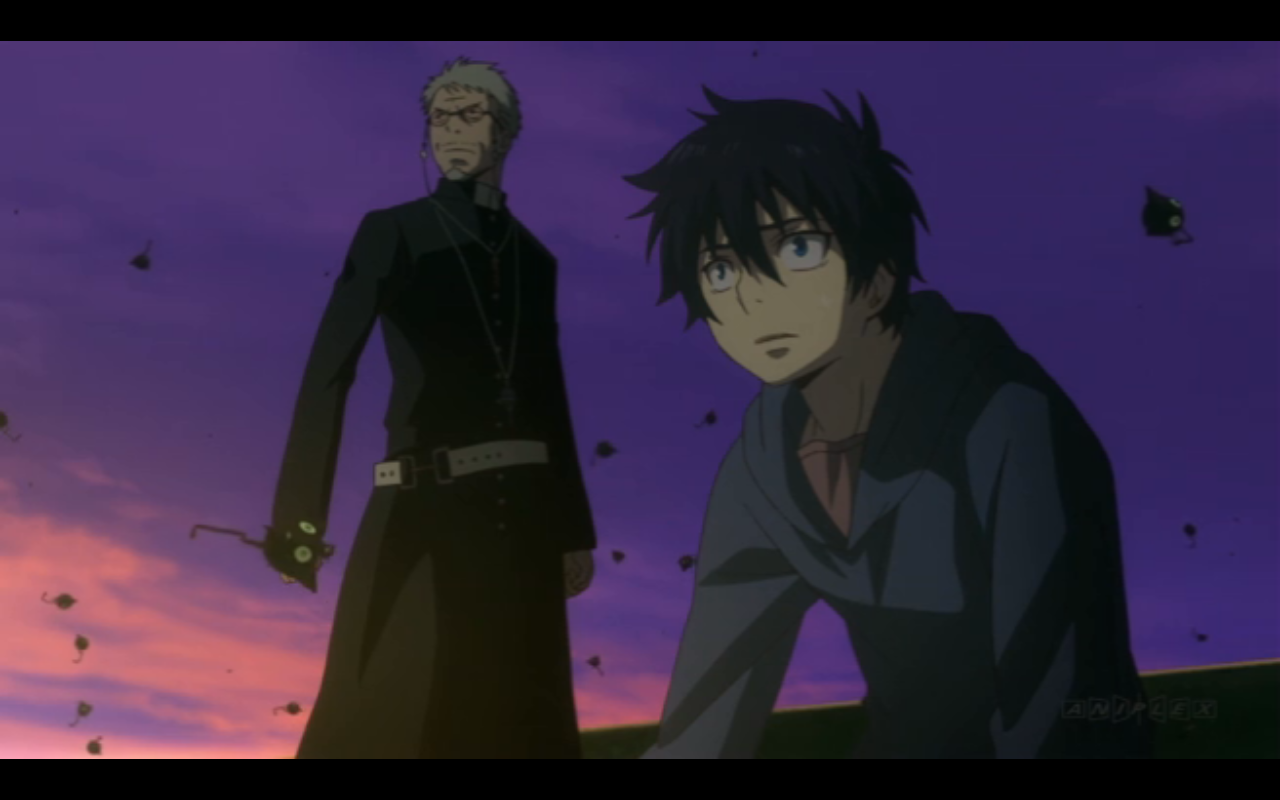
Rin's adoptive father, Fujimoto Shirou, tells him more about his
heritage in episode 2. I'm surprised to realize I remember this scene,
and I know it's because of the lovely visuals.
That 2012 post I linked to, "Blue Exorcist - My thoughts upon finishing it," could be called an informal review from a religious perspective and a just plain critical perspective. Looking back, I think it was a good for me to write that. It gave me practice in looking at religious elements in anime. 

I have an embarrassing moment attached to that post, though. For some reason, I assumed the original mangaka, Katou Kazue, was a man. She's not. A commenter corrected me, I thanked them, and I went back and changed all the pronouns. I now do my research properly before I list names.

My old post gives a pretty good idea of my opinion of Blue Exorcist. But I can elaborate on it. Over the past few years, I've started to see Blue Exorcist in a more positive light, probably because of positive comments and posts around the web. So, when I look back at my Anime-Planet rating, I'm surprised to realize I only gave the show a 3.5 out of 5 stars. I guess I was starting to get a little harsher with my star ratings by then. Not long before, I'd been terribly generous, giving out 5s like free candy.

I enjoyed Blue Exorcist, but, in my [past] opinion, it didn't get very far past mediocre. I plan to re-watch a few episodes on Toonami, to see what I think now. In fact, I already re-watched through part of the second episode on Crunchyroll, and I definitely looked at it in a slightly different light. It will be interesting to try the English dub. Plus, it's an excuse to use the TV in my rented room - that thing has been useless since the last episode of Sherlock aired on PBS.

I plan to use Blue Exorcist as practice more purposefully this time around. I've been thinking about what it means to thoughtfully consume media, and, in the past year, evaluating worldview and religion in media has been a theme in my classes. I've also grown a little more aware of how things look on the screen and who's behind it (only a little - baby steps). For example, I'm starting to take note of studio names; Blue Exorcist came from A-1 Pictures, as did Working!! and Servant x Service. Sure, I got it mixed up with Production I.G., but hey! I'll take the improvement, even if it's embarrassing that something so small is still a very recent accomplishment. 

Friday, January 17, 2014

Rewind: Natsume Yuujinchou

I'm amazed at how much my tastes changed just in the past few years. Once upon a time, I wouldn't watch anything that didn't promise action. I slowly expanded to other genres. Anime showed me that not all comedy was embarrassing, and romance could be fun. Still, as I browsed anime entries on Anime-Planet, there were a few descriptions I avoided, including "episodic" and "slow-paced." I was in love with long plots and fast paces. Surely anything else would be boring.

Nowadays, I'm open to anime that take their time. I savor peaceful scenes as much as battle scenes. I appreciate the portrayal of real feelings as much as fantasy. I know that slow-paced anime can be some of the richest on my list. I don't have to immerse myself in action-filled fantasy, and I'll even watch slice of life.

A youkai, Nyanko-sensei, and Natsume in the second episode.
This youkai, like many others, has come to Natsume in order to get his
name back, which his grandmother had taken from him. In the process,
they become friends.
This change may be partially due to maturity. As might be expected, I grew a lot between my sixteenth winter and my twentieth. But at some point, I had to step outside my box and watch something with that drab "slow-paced" label. The show that did it for me was Natsume Yuujinchou.

I'd noticed Natsume Yuujinchou, or Natsume's Book of Friends, pop up as I browsed Crunchyroll and Anime-Planet. It was popular. The "fantasy" tag interested me, but the "episodic" and "slow-paced" tags turned me off. Still, as I recounted two years ago, I eventually gave in, and I loved it. I followed the fourth season as it aired.

While each episode had its own conflict, there is overarching character development and plot to give it continuity. Natsume is a high school student who has been passed among relatives since his parents died when he was young. He's endured rejection and loneliness for years, largely because he can see youkai, and no one else can. He's been called a liar and troublemaker, he's lost friends, and no family keeps him for long.

At the beginning of the show, Natsume moves in with a distantly related couple that is different than the others, more gracious and genuinely caring. Trust and a sense of family develop throughout the four seasons (or series, if you prefer, since they weren't aired consecutively). He makes friends with his schoolmates, and if they notice anything strange, they don't desert him over it. He stops running away from the youkai, finds out why he can see them, and makes friends with many of them. He learns about others who are lonely, and he learns that people do care for him. He is still in a very unique situation, but he is not alone.

The themes of loneliness and friendship have been important to me for a long time. I went through a lonely phase in high school, and twists in my thinking convinced me that no one needed my friendship, at least no one in the vicinity. I did, at least, have my mom to talk to, and I wrestled through things with God, but I still felt isolated. I don't think the feeling was at its worst when I watched Natsume Yuujinchou, but I still wasn't in great shape at the time. It was soothing to watch Natsume become less lonely.

There were other things I enjoyed, of course. Shintoism plays a key role in the set, premise, and characters, so that is fascinating to watch. Nyanko-sensei, known to most youkai as Madara, is an amusing character, and impressive in his full youkai form. Further, it's always fun to build vocabulary, and, as you may have noticed, "youkai" now flows easily off my tongue or keyboard. [Come to think of it, I should probably put that in my glossary. My understanding is still limited, so I struggle to find an appropriate English word. Perhaps "spirits" will do for now. The Japanese word just holds so much more richness, as "youkai" has the proper connotations, and "spirits" has other, Westernized connotations.]

When I think of peaceful anime, Natsume Yuujinchou is often the second to come to mind, after My Neighbor Totoro. It's interesting to realize the prevalence of Shinto elements in both of them. I have not done enough research to say much more on the religion, but these anime remind me to appreciate the little things in life and nature. They help me to slow down, take deep breaths, and smile. My perspective is different than the one in these anime. When I watch the wind ruffle branches or birds hopping along the ground, I see beauty created by a loving and present Creator. Still, there's no denying that Natsume Yuujinchou and the other shows got something right, and it's a delight to take part in it.

Monday, August 13, 2012

Thoughts as I Re-watch Fullmetal Alchemist: Brotherhood

After at least a year of saying I'd do it, I've finally restarted Fullmetal Alchemist: Brotherhood. I think I watched about thirty episodes of it two years ago (maybe more) before stalling it and watching Fullmetal Alchemist instead. I can't remember why exactly I stalled it. Maybe the dark and bloody parts had gotten to me (the last scene I remember watching from that bout of Brotherhood was a scene in Gluttony's stomach). Maybe I just wanted a cleaner, more straightforward storyline. I don't know. Now that I've restarted it, I find the plot in Brotherhood quite understandable.

I re-watched Fullmetal Alchemist the Movie: The Conqueror of Shamballa a week or so ago and decided, "Hey, I still haven't finished Brotherhood. I should do that now. I want to see more of Ed and Mustang and all of those cool people."

I've re-watched the first twenty three episodes of Brotherhood now. Since I haven't blogged about anime in a while, here are a few thoughts:

1. I forgot how bloody and serious parts of this anime are.
The setting and plot are deeper than most anime I've watched. This show deals with racism, government corruption, genocide, human experimentation, grief, and revenge, along with other topics. It's interesting, thought-provoking, and at times hard to watch. Poor Nina...

2. There are some religion pieces in this series.
As a Christian, I take special note of the episodes near the beginning of this series (episodes two and three, I believe). How can I not? There's a corrupt priest misleading the people and betraying their trust. And the main character, whom I happen to really enjoy, denies the existence of God.

On the first point, I can relate the corrupt priest to several charlatans and corrupt churches throughout history. The fictional evildoer frustrates me almost as much as the real ones. I get quite annoyed when people try to use God's name for their own gain, particularly when they hurt thousands of others in the process.

On the second, I can't do anything about a fictional character's perspective on the universe. And I probably can't convert a mangaka who I won't ever meet. I can pray for her, but that's about it. So I enjoy Fullmetal Alchemist, atheist characters and all.

3. The humor and sketchy/diminutive art provides a nice contrast to all the serious and dark parts of the show.
Ed's prickliness about his height never grows old. Nor does Winry's reaction when he bangs up his automail. ^_^

4. Al had a particularly epic scene in episode 19. I had to take a screenshot for my background.


Well, that's about it for now. I thought it was about time for me to blog about anime again, so here it is. A few unrelated notes: I start college really soon. I'm refreshed after my year off and ready for school! I wonder how it will effect my various hobbies. I already have a hard time juggling anime, blogging, At His Whim, other writing, other TV, reading...

Sunday, January 1, 2012

Blue Exorcist - My thoughts upon finishing it

I just finished watching Blue Exorcist. It was an interesting anime. I came away with a few thoughts, from a religious point of view, from a critical point of view, and about things I liked. It's about time for another anime post, so here we go.

Blue Exorcist in a nutshell:
This anime is about a teen, Okumura Rin, and his twin, Yukio. They're the sons of Satan and a young human woman. At the beginning, Rin has no clue about his heritage - they were raised by Fujimoto Shiro, a kind priest and exorcist. Then a few unfortunate things happen, Rin's demon powers are revealed, and he finds out the truth. Suddenly, he has a new goal in life: to become a great exorcist and take down Satan. He makes friends, learns more about his power, and fights demons.

Basically, it's a classic shounen anime that follows a route similar to other popular shounen anime. It's just about demons and exorcists, rather than martial artists or soul reapers.

From a religious point of view...
*Please note that, unless otherwise specified, the demons I compare Blue Exorcist demons to are those found in the Bible, not the ones found in other religions or legends. Also note that I take the Bible as truth, so I won't bother with hesitant phrases such as "I believe..." or "in my faith..."

I first noticed Blue Exorcist around Crunchyroll and Hulu when it came out back in the spring. It looked somewhat interesting. However, I had definite reservations about it. I'm a Christian. To me, Satan and his fellow demons aren't just interesting creatures to write stories about, nor are they to be taken lightly. They're fallen, evil angels who defied God. I'm not paranoid about them - God is ultimately in control, and has the power to overcome and prevent anything demons may try. There's a reason Satan doesn't have free reign on earth. Still, he is real, and the idea of defeating him without God is ludicrous to me. It might make for an interesting storyline, but it's still ludicrous.

Thus, I planned to avoid Blue Exorcist and enjoy anime that wouldn't bother my serious, conservative side. However, someone on Wattpad recommended that I try it out, so I did. I decided that I wouldn't get offended. I'm used to anime borrowing from customs, theology, and text associated with Christianity. Worst case scenario, I'd decide Blue Exorcist delved too deeply into things I hold as serious, and I'd have to drop the show partway through.

I didn't drop the show. However, I did raise my eyebrows at several things, and I wouldn't recommend Blue Exorcist  to any Christian who is easily offended. I'm not condemning this anime... but the religious aspects did hinder my enjoyment.

Okamura Rin in 2nd ep, displaying his powers
To begin with, the creators (or more specifically, Katou Kazue, who came up with the original story and manga), misrepresented what demons are. I think Katou crossed Biblical facts about demons with Japanese culture and myths, along with her imagination. Depending on the presentation, I don't usually care about this. For some reason, I did this time. Demons were portrayed as their own type of creature. Most of them were bad, but some of them were good and sided with the exorcists as "familiars." Satan, who was still portrayed as evil, even fell in love with a human.

Katou took the parts from Christianity that were found useful to her story and ignored the rest. She took Satan and demons, but ignored the good angels, not to mention God. She took the priests and Bible excerpts, but ignored the One who inspired the Bible and Whom the priests serve. Then she borrowed a few things from Buddhism and Shintoism. These, along with her imagination, all contributed to the exorcists and demons in the original manga, and then the show.

I don't blame Katou for incorporating parts of the Christian religion and beliefs into Blue Exorcist. They spurred her imagination and turned out quite the fantastical story and characters. Yet my mind was on guard as I watched the anime, always identifying references to Christianity, as well as fictional takes on demons.

From a just plain critical point of view...
Between watching anime, blogging about it, and writing a few reviews, I've naturally developed a more critical eye. So there were a few things about Blue Exorcist that bugged me.

If you've watched much anime, especially in the shoujo and shounen veins, the following scene should sound familiar:

"We're your friends. We're all in this together. So we're going to stick with you until the end."
Hero(ine): overly touched, humbled, completely shocked at friends' declaration, likely speechless. May say "Thanks, everyone!"

Sound familiar? Guess what? Blue Exorcist has a couple of scenes like that. Of course, at least one of the same super loyal friends had been predictably suspicious of the main character only an episode before, but let's not dwell on that, shall we?

Okay. Moving on... I'm a sucker for good family relationships, especially between siblings. So I appreciated Rin and his twin, Yukio's, support for each other. Yet there were times when their support went from sweet and cool to watch to mushy and over done, like the friend scene above.

Overall, the characters weren't much. Sure, Okumura Rin was pretty cool. And some of the other characters put up enjoyable shows. I particularly liked Rin's adoptive father, Fujimoto Shirou. But, for the most part, the characters and their stories were neither original nor deep (though deepness was attempted). There was the sweet, shy, beautiful girl, Moriyama Shiemi. She had her uses, but she was mostly just sweet and shy. And by sweet, I mean sweet and selfless in the way only fictional characters can be. The kind who happily lets her "friends" take advantage of her. Ugh. Then came the tough guy, the hopeless wimp, the tsundere (correct me if I'm wrong, but I believe Kamiki Izumo qualifies as tsundere), the scantily-clad warrior, and so on.
The Okumura twins.

The things I liked...
There had to be some reason I watched the entire series, right? I mean, I did enjoy it most of the time.

The first thing Blue Exorcist had going for it was the relationship between the twin brothers. Like I said, I'm a sucker for things like that. I also loved their adoptive father and the monastery they grew up in. Okumura Rin was a fun character to watch nearly 100% of the time, even if he was pretty predictable and threw me no curveballs.

What else? There was action, which I always love. The animation was smooth, and the character designs generally pleasant to look at.

Basically, Blue Exorcist kept me interested by pure entertainment value.

In Sum:
Despite my misgivings, I ended up enjoying Blue Exorcist. Sure, the religious aspects sometimes rubbed me the wrong way, and there were a couple cheesy, overused moments. I wouldn't recommend it to any Christian who is easily offended. Still, I think most fans of shounen anime would like Blue Exorcist. 


*All pictures are from the anime Blue Exorcist and, obviously, do not belong to me.

Friday, May 20, 2011

Vineyard Roots - A Talented New Blogger

I haven't posted in a week, and even that barely counted as a post. This was partly because I really can't procrastinate on my homework anymore, partly because I just discovered Smack Jeeves, and partly because I'm trying out a few more story ideas instead of writing things I want to post here (whether these stories will last more than a dozen pages remains to be seen). I can't believe how quickly I went through my pile of back up posts.

Anyway, a friend of mine just started a blog, Vineyard Roots. She's already posted three essays and three short stories, and let me tell you; she is an excellent writer. She has a bit of otakuphobia, so you won't find anything anime-related on her blog, but I recommend checking it out anyway. I found her post "God on a Bus" particularly interesting. Her thoughts on the battle of London bus ads between Christians and atheists make a very good read.

Another little note: the professional look of her site puts me to shame. I'm definitely moving up my plans to add an about page and organize my blog. After I finish my few dozen hours of homework.

Monday, January 24, 2011

Succinctness is Not my Gift

This past Saturday, I started reading and responding to a forum thread titled, basically, "General Religion Discussion." In this thread, people posted the basics of their religious views (i.e. "Atheist," "Catholic," or "Muslim"). Including me, I think a total of three Christians contributed. One of them, TWWK, said he was open to questions about Christianity, and the questions poured down (by the way, he has an interesting blog about Christianity and anime - look in the list of blogs I follow).

I spent over five hours and almost seven pages of Word responding to the first 6 out of 10 pages of discussion on Saturday, then returned on Sunday, and again today. This is a great opportunity to learn about other religious views, and to discuss my own faith. I just wish I could learn to say things in a shorter way. I'll post one of my responses here, just to give you an idea. The notes in brackets are to help you understand what's going on, newly added for the blog.


Oh, but I thought that subject [reliability of the scripture] was fascinating! Of course, I consider Calculus to be fascinating as well, so maybe I'm not the best judge...


[one of the other users thought I just couldn't imagine or cope with a world without God] I've tried imagining a world without God before. It's hard, since I think of God as a concrete, definite existence, just as much as the wind or the president of the USA or water. But I'll try again. First I have to bypass the little issue of whether the world would even exist without God, let alone be inhabitable, or have inhabitants, let alone inhabitants with any sense of morals. Once I push those aside, I can begin imagining the effect on me personally.


I love sound logic, so I'd reject any religion presented to me, unless I could find scientific, historical and social (like sociology) reasoning behind it. And without God, there would be no such religion. I'd look at what makes me happy and agreeable and create a set of "moral" guidelines to hold myself and my peers to, and devote myself to making a community bases on those morals. Sometimes I'd wonder what the point of my life and my mind was. If we just happen to be here, just happen to be smarter than other creatures, are the things I call "bad" truly wrong? What makes stealing, lying, or even murder wrong? I'd wonder why I should bother trying to fix things if there was no point, and why I shouldn't just end my life and disappear into nothingness. Then I'd shake myself out of that mode, call myself weak for wanting to escape, and find a new project, a new way to build my world and myself into what I call "good." My only truth would be that I am me, and that I can do anything I want. If I still felt empty, I'd try to fill that emptiness with hobbies - anime, reading, playing piano. I'd revere logic and my version of "good," and my life would revolve around those two principles. In a sense, I'd be my own goddess.


Perhaps that wasn't so hard - I just had to imagine a lifetime of forgetting about God. And since I do forget, doubt, and ignore more often than I care to admit, I just had to multiply the intensity and length of those moments to get an idea of how I'd cope without God. On the one hand, it does sound thrilling, like I'd have power. On the other hand, it sounds like I'd be building an illusion - and I'd know it. Such an empty life does scare me, but that's not a logical reason to believe in God. And, like I said, I love logic.


I will say that I don't listen to God's word just because "there is someone watching who will fry my ass later on." [not my words - the other user's] If I relied on my good deeds and regular prayer to get me into heaven, I'd have given up by now - there's no point in trying to be perfect enough for God. If I'm going to be punished anyway, I may as well live for myself now.


By truth, I mean moral truth. Most people agree that 1 + 1 = 2 and that if you get hit, it hurts. Those are "truth"s. Though, from a purely philosophical standpoint (and without the God factor), I wonder, does it really hurt? Or is it an illusion, a reaction I made up to fit the world around me, which in turn is mostly illusions that people before me created? And at that point I realize I'm getting ridiculous and go for a walk or something tangible that doesn't include turning circles within my mind.


I think some preachers (and I) use "high words" and "weird grammar" sometimes because we are exposed to those with frequency and so our thoughts naturally fall into that pattern. That's where I start searching for words besides "righteousness," "ultimate truth," "salvation," and such. I already stopped myself a few times from using the word "covenant." :P Since I both grew up in the church and am an over-thinking type, it all spills out before I realize that not only do most people have a different thought process, but they aren't interested in all the religious-sounding wording. I sometimes wonder what people think when they walk into church fro the first time and hear words and grammar that I forget aren't common in most folk's daily life.


And don't worry, I won't take anything personally if you don't. We're just exploring religion (especially, it seems, Christianity) and opinions here. We have to be polite, but no good discussion will come from trying not to step on anyone's toes. Let me know if I seem to sidestep a question or if it sounds like I'm spouting well-disguised fluff.


Long, isn't it? What can I say? I clearly lack the gift of succinctness.

For the full discussion, check it out under "general discussion" in the forum at anime-planet.com. You don't have to be logged in to view it.