Showing posts with label friendship. Show all posts

Saturday, December 13, 2014

Rewind: One Week Friends

One Week Friends, or Isshuukan Friends, is a gentle drama about friendship. The main girl, Fujimiya Kaori, can't remember any of her friends for longer than a week. Her memory resets every Monday. Still, the gently heroic protagonist, Hase Yuuki, is determined to be friends with her. 

For the second Monday in a row, Hase asks Fujimiya to be his friend. (ep 1)

It sounds slow and potentially overdramatic. That selective memory loss premise is borderline ridiculous, right? But I noticed a few people talking about it online, so I gave it a try. 

I watched most of the episodes on my phone, often during lunch breaks at my summer job, or in bed right before sleep. It was the perfect show for breaks: I was interested, but I didn't care quite enough to wish I had a bigger screen.

The plot wasn't thrilling, but I couldn't help but care for the characters. Hase-kun chose to be friends with Fujimiya, even knowing that he would have to introduce himself again the following Monday. Fujimiya was a sweetheart who spent hours in the kitchen to find out exactly how much sugar Hase liked in his eggs (yes, sugar... maybe it's a Japanese thing). And Hase's friend, the aloof Kiryuu, easily won me over. He seemed introverted (which I identified with, of course), but he gave great friendship advice to Hase as needed. 

In One Week Friends, Hase and Fujimiya explore what it means to be friends. It can be a little painful at times—they are, after all, awkward teenagers exploring friendship, and Fujimiya's memory loss complicates matters even more. But it's worth it for them, and it was worth it for me to watch. I'm getting better at this whole friendship thing (thank the Lord for college!). Still... I may or may not take mental notes when I see a good example of friendship, whether it's fictional or real. 

That's pretty much all I have to say. If you watch One Week Friends, take note of the visuals—the edges are always slightly faded out, which adds to the gentle feeling. I gave it 4.5 out of 5 stars: it's a pleasant watch without glaring faults, but not a favorite. 


Friday, December 5, 2014

Hints of the Eternal Story in Gungrave

Dead week is ending, finals are coming, and I'm more Swamped than ever. Thankfully, a little over a month ago, I had a chance to center my homework around Gungrave, my favorite anime. We were to write a brief paper about how something from pop culture reflected truths about God's story. I'm changing some wording to fit this blog's audience better, but other than that, I'm pretty much posting the paper as-is. And adding screenshots.

---

This is a very brief overview of some ways that Gungrave reflects truths about us and about God (most likely without the makers realizing it). Eventually, maybe I'll write in-depth posts about some of these details. Also, I'd like to analyze what the main characters' values are, and how they contrast with a Christian point of view. But not today. Today, I focus on hints and reflections of truth.

*Spoilers ahead!* Pretty much all the important parts of the plot are spoiled. So read at your own risk. If you're interested in a more "typical" review with less spoilers and a little bit of fangirling, see my Rewind post from 2013.

Summary of Gungrave 


Gungrave is an anime that crosses mafia drama with science fiction. It centers around loyal Brandon and ambitious Harry, best friends who, as young men, become involved in a mafia-like syndicate called Millennion. They work their way up, into the leader, Big Daddy’s, inner circle, or “family.” Then Harry prepares to betray Big Daddy and everyone loyal to him. This includes Brandon. But Brandon anticipates this. Before Harry kills him, he makes arrangements for a procedure that allows him to become “Beyond the Grave.” Thirteen years later, Brandon returns to kill his best friend and everyone else who betrayed Millennion. It’s love and honor that drive him to kill, not hateful revenge. This is beautifully illustrated in the last episode, when he and Harry die together in the abandoned cafe they lived in as street kids. 

Brandon is on the left of this screenshot, in the black suit. He is an enforcer
for Millennion, which means he does the dirty work associated with avenging,
protecting, and enforcing a code of loyalty. He works in the dark, while Harry
wears the white suit of budding leadership. But in this scene, Brandon is the one
standing in the light, as his best friend's true colors are finally
revealed. Love the symbolism of this! (ep 14)

Hints of God's Story


Brandon provides an illustration of God’s unconditional love, paired with his justice. He still loves Harry, and he gives him ample opportunity to change. But when Harry won’t turn back, Brandon prepares to kill him. He further echoes Jesus when he is killed by Harry, and when his other comrades join Harry’s betrayal. He dies at the hands of the very people he loves, but he does not resent them. Instead, he returns, to bring “justice” and, to what extent is possible, reconcile relationships. Similarly, Jesus died and rose again without resentment, to redeem us from sin. And, also similarly, Jesus will return to judge the living and the dead.

Hints of Creation [Of who and what we were made to be] 


Deep relationships, especially platonic and familial ones, provide a strong theme throughout Gungrave. Before the Fall, Adam and Eve had a pure relationship between themselves and God, untainted by deceit or greed. Humans aren’t made to live alone, and that shows in Gungrave. Brandon is especially good at valuing fellowship, but Harry gravitates to family-like groups, too. First, it’s their little gang in the slums. Then, it’s Millenion. Harry even gets married. Since wives, unlike best friends, are kept out of mafia business, he enjoys a relatively fulfilling relationship. 

Hints of Fall [Of how messed up we've become since the events recorded in Gen. 3]


Death, specifically murder, is an obvious hint throughout Gungrave. But the hints that resonate more deeply come from broken relationships. Sin prevents Brandon from a relationship with his beloved Maria. He is too involved in underworld dealings—and too loyal to Harry—to be a stable man for her. When stated like that, it sounds like an illustration of the separation between God and Man after the Fall. (Now there is a topic I'd like to explore—Maria and Brandon's relationship as a reflection of the human condition.) Most glaringly, Harry does not understand that selfless love and loyalty are infinitely more valuable than power and money. Thus, he accuses Brandon of betraying him by standing in his way. Instead of trusting his friend’s goodwill, he kills him—much like Eve and Adam chose not to trust God’s command. Harry misplaces his trust and confuses his priorities, just like so many of us do when blinded by the allure of sin. 

Hints of Redemption [Of reconciliation, bringing us and the world back into our proper relationship with God]


There is an echo of redeeming love in the last episode of Gungrave. Brandon finally begins to get through to Harry, to remind him of the friendship they used to have. At times, the screen shows them as their younger selves, from before Millenion.  Past and present mix in their last minutes, and they see dead friends. This gives hints of an afterlife, and of reunion with loved ones. With Brandon’s last words right before they shoot each other, he suggests they return to their childhood, to days of freedom. In the last scene, they do just that. We see the day Brandon and Harry meet at the orphanage. It shows restoration of relationships, innocence, and freedom.

Conclusion


This is one of my favorite anime, and I’m sure it’s largely because of the elements outlined here. It shows the broken nature of human life and relationships, but it also values both of them very deeply. God isn’t acknowledged in this anime, but it does acknowledge our ability to love despite the worst, and without letting go of justice. That is something that God created, that reflects him, and is beautiful even in the most broken settings.


Monday, October 6, 2014

Listen to Their Passion

Today's Blimey Cow video is titled "The Fandom Menace (or: Why I Hate Fandoms)." I've enjoyed many of their videos, but this time, I'm at least a small part of their rant's target. I reminded myself to keep an open mind before I clicked play. Sure enough, it was not my favorite video (although I liked it better once they moved past TV fandoms to celebrity "cults"). I understood where they were coming from, though, and I knew better than to be offended (hyperbole and sarcasm abound in all their rant videos). Still, I had to respond... especially after reading some of the comments.

This post is, in part, a personal explanation and defense of fandom and passion. However, this is addressed to everyone, no matter their current relationship to fandom. You can watch Bimey Cow's video first, if you want, although it's not necessary:


I'm an anime fan, but I can, to some extent, appreciate both sides of this issue. I try to be responsible about my fangirling, but it's a learning process. Sometimes, I blab about anime too much, and I know it. Since I love anime, it's often on my mind, and it's hard not to talk about it. This applies to anything I'm passionate about, and not just my fandom. I'm still learning how and when to keep silent.

Here's the thing about some of us nerdier fans: we know we're not "normal," even without hearing Jordan say so. And we're often self-conscious about it. It's not that I want to meet all the qualifications of "normal," but I don't want to alienate myself from the so-called normals, either. Nor do I want to alienate other fandoms.

There's another side to my experience, though: In the online anime community, I encounter a lot of otaku more passionate and knowledgable about anime than I am. And, since there are so many anime out there, we all have our own favorites, and which may or may not include esteemed "classics." These two facts occasionally cause insecurity. For example, I've questioned whether I really qualify as a fan of certain show when I can't even keep the characters' names straight. It's like I need permission to simply enjoy without obsessing. But that's something I have to sort out for myself. I have to come to terms with my level of investment in a particular facet of anime fandom. Once I do, I enjoy listening and learning from the more extreme fans. After all, they don't mean to make me feel insecure. Every now and then, I do encounter someone who likes to show off their superior anime knowledge or taste in shows. This is rare in my circles, but I've seen some of the negative affects of such attitudes. I keep these experiences in mind, and try to avoid sounding judgmental or condescending when I'm in opinionated-fan-mode myself (especially when I've got budding anime fans around me, and I don't want to scare them off).

So, here's what I've learned: all of us, fans and non-fans, need to shut up sometimes and love by listening—really, truly listening. We need to be okay with our differences, and enjoy them. I might never have the combination of time and interest to get into Doctor Who. But I'll happily listen to friends talk about it, and I'd enjoy watching a couple episodes with them. It's fun to watch people geek out about what they love—their faces light up. If, however, I were to reject Doctor Who entirely, a Whovian friend might feel like I'm rejecting part of who they are... and, in fact, I would be. I don't need to love Doctor Who to love a Whovian friend; but I need to appreciate its importance to them. And they'll hopefully realize that, when I don't become a radical fan, I'm not rejecting them. I'm just enjoying our differences.

Oh, and this logic doesn't just apply to fandoms: if Grandma is passionate about quilting, I should listen to what new techniques she's learned and ask to see her latest project. If my younger cousin loves playing soccer, I should learn why, and maybe ask her to show me some moves. If my friend is passionate about any cause or interest, I should listen. I confess, I'm not always great at initiating these conversations, but it's a social skill I want to develop. Because when someone expresses interest in what I love, I know they care. And I want to show other people that I care, too.

If I only talk about what I am passionate about, I can be part of what they call the "fandom menace." If I spend too much time complaining about or belittling other fandoms, then I become part of the anti-fandom menace. Either menace is annoying, occasionally hurtful, and never loving. The easiest way to avoid becoming that? Pay attention to what someone else likes or doesn't like. And legitimately care about their opinion.

Wednesday, July 2, 2014

An Introvert's Guide to Boundaries and Friendship Behavior

I've mentioned this before, but friendship isn't exactly my area of expertise. For several of my teen years, I was pretty lonely. Not friendless, but lonely. My longtime close friends lived in another town, and I was convinced it was impossible for me to make new friends, or to deepen the friendships I had at school. It took several years and three semesters of dorm life to gain the relative confidence I have now.

Of course, I'll always be an introvert, and I'm still clumsy when it comes to friendship. So I guess it's no surprise that I liked The Kawai Complex Guide to Manors and Hostel Behavior, an anime about Usa, a normal guy, and his introverted senpai, Ritsu.

Usa is on library duty when he first sees Ritsu in episode 1.
It's a rather affirming anime for me, as an introvert. It gives assurance, through the kind Usa-kun, that a friend (even, maybe, a potential love interest) could care enough to work with my need for quiet time. It also gives a lesson on how to draw boundaries and retain sanity after making friends. I've learned some of this through my own experience with the wonderful people I've met at college. So I know that, as ridiculous as Kawai Complex can be, it's not wrong about basic friendship things.

That's one reason that I like Kawai Complex so much. But there's one other thing: this anime portrays introversion extremely well. Each introvert is unique, because we're each a unique person. My needs and comforts are slightly different than Ritsu's. I don't always hate events with lots of people. But I'm still just as introverted as she is, and I feel like this show might advocate for introverts a bit.

[Before I write more, a disclaimer: there's a lot of sexual "humor" in Kawai Complex. In fact, there's so much of it, I'm surprised Hulu doesn't show it as TV-MA (seriously, though—Hetalia gets the mature rating, and Kawai Complex doesn't? That ain't right). I don't like any of the sexual humor, but I like Usa and Ritsu well enough, so I watched all 12 episodes.]

What's so great about how Kawai Complex portrays introversion and friendship?

First, they emphasize the difference between being alone and being lonely. Ritsu loves reading by herself, and she doesn't necessarily want to be interrupted, even if there are people having fun nearby. I can identify with that. Sometimes, at big events, I like to just sit to the side and observe, write, or read. And I'm content.

Of course, introverts can still get lonely, and we appreciate friendship. I think Kawai Complex shows that well. It includes the "what not to do" approach to friendship in the eleventh episode, when Rit-chan seems to make a new friend.

My fellow introverts, in the last two episodes of Kawai Complex, we learn a valuable lesson about boundaries. Boundaries can be hard, especially if you want people to like you, and especially if you finally have someone who's pursuing friendship with you. However, boundaries are necessary. Without them, we may go insane and lose our ability to be good friends to anyone.

For example, I dislike holding any significant conversations over text. It's cumbersome, even though I have a full keyboard, and I don't like feeling obligated to answer immediately. So, when I give my number to a friend who might be a texter, I say something like, "Just so you know, I'm not a big texter. I like texting about little things, since it's convenient and efficient, but it's not my favorite way to talk. I do better with chatting online or on the phone."

If I don't set boundaries with my phone, I feel exactly like Rit-chan
looks in this frame from episode 11: worn out and annoyed.
If I get sucked into a texting conversation anyway, I first consider my friend's feelings. I don't want to hurt them. Sometimes, I'll suggest that we move the conversation to chatting online. If I do stick to texting, I purposefully space out my replies, so they don't get used to my immediate response. I don't want them to get worried when I don't respond for over an hour.

And sometimes, whether it's by text, internet, phone, or even in person, I simply say, "Okay, I should really go now. I have things I need to get done (including recharge with alone time)."

There were times, especially when I lived in the dorms at school, when I didn't know how to set the boundaries I knew I desperately needed. There were girls in my hall who I really did like. They had tender hearts and a lot of conversation and emotion to share. But eventually, I ended up like this:

Ritsu complains to Usa in ep 12.
I called my parents one afternoon my freshman year, and I said something like this: "I love this girl, but I can't handle her coming by my room all the time! I don't want to cut her out completely, and maybe we can have lunch in the dining hall sometime, but I'm stressed out, and I need to be alone and at peace!"

Actually, I'm pretty sure I've called my parents with similar problems on multiple occasions, but that particular call to Dad sticks out to me. With his encouragement, I knew I needed to gently draw the line. The other girl was as understanding of my need to be alone as any extrovert can be. At the very least, she understood that too much interaction could trigger my anxiety.

For my part, I filled a couple pages of my journal with prayer, Bible verses, and problem-solving. I knew that, at times, I needed to give up my alone time for the sake of another person. My well-being was important, but it was neither more nor less important than my friend's. I asked God for help loving my friends and, at the same time, finding balance. When I drew a boundary between me and another person, I didn't want that boundary to leave them completely in the cold.

Exuberant, extroverted people occasionally struggle to understand our needs, and, sometimes, friendship with them doesn't go beyond surface-level interaction. In Kawai Complex, Ritsu started to make friends with a fellow book-lover… but the other girl was far more extroverted than she was, and was utterly exhausting to be with. She wasn't considerate of Ritsu's feelings, and she didn't take the effort to understand when Ritsu explained that she didn't like certain social events or too much emailing. Instead, this other girl dismissed Ritsu and went back to friends that were "on the same wavelength" and enjoyed nearly 24/7 interaction.

Later in the twelfth episode, Ritsu stated that she couldn't make any friends. In the screenshot below, her reasoning is shown in blue letters: "I don't think I'll ever find someone on my wavelength!"


It does get discouraging. Ritsu isn't just a little bit introverted, and she's not just a casual reader. She seriously can't handle too many people, or too much time actively hanging out with anyone. And she seriously loves her books. How will she ever find someone who needs and likes the same things she does?

I've wondered the same things. I'm not just a little bit introverted. I need more than a few hours to recharge each day, and I often go weeks before I need to hang out with a friend. And I don't just kind of like anime… I really like it. Most of all, I like being an aniblogger. Writing and my time online (limited as it my have to be, when even social media becomes too social for me) are important to me. How will I ever find a friend who shares both my introversion and all of my hobbies, a friend who knows me both online and off?

The answer is that I probably won't, and Ritsu won't, either.

So, people are exhausting, and we'll never find anyone that's exactly like us. Thus, we can't make friends. Right?

No. That's an easy statement to say, with reasoning that we can hide behind, but it's just a coward's shield. Here are some other lines I've said:

"None of the other girls here need friendship like I do. They already have good friends, so they don't need me. I'd just take their time and energy unnecessarily, and they'd share their hearts with the friends they already have."

"We all graduate and go to different colleges in less than a year, anyway. That's not enough time to make a good, lasting friendship."

"I don't have the energy to make friends, and I don't know how to anyway. Putting myself out there anymore will just worsen my anxiety."

If friendship is impossible, then we don't have to try, and we don't have to be hurt if we're rejected.

But it's not impossible. And if we don't try, it still hurts.

One of Ritsu's older housemates had a great response when she despaired of ever making friends. She told Ritsu that it doesn't matter if you match wavelengths. What matters is whether you can get along anyway.

And that's true. I had a great roommate last fall, the last semester before I moved out of the dorms. We were pretty different. She needed a fair amount of people time, while I couldn't get enough alone time. Our hobbies overlapped, but only barely—she still hasn't seen any of my anime. But she was sweet and considerate. And now, I consider her to be a dear friend. Sure, we didn't start out on the same wavelength. So we kind of made a new one between us. I enjoyed listening to what was important to her. And, after I moved out, she actually said she missed listening to me talk about anime.

Friends help each other grow. They learn to appreciate, and even enjoy, the things that are important to each other.

When someone shows any level of interest in what's important to me, I'm happy. If they start investing time and effort in me and in learning about my interests, I'm thrilled. That's why I love Usa-kun so much; he invests not only in an idealized version of Ritsu, but in learning about the real her. He doesn't ask about her books just because he wants to win her over or even, as he said, "to make her feel better. I'm genuinely interested. I want to learn to enjoy the things Senpai enjoys."

Of course, Usa is interested in Ritsu as more than just a friend. But he's starting out that way, and I expect their relationship will slowly develop, even if we don't get to see it on screen. Since their relationship is potentially more than friendship, I have even more interest. Because if a girl questions her ability to make friends, she's definitely going to question the idea of anyone pursuing her as more than a friend. But that's a bigger, more vulnerable topic. So I think I'd better end here.


Friday, January 17, 2014

Rewind: Natsume Yuujinchou

I'm amazed at how much my tastes changed just in the past few years. Once upon a time, I wouldn't watch anything that didn't promise action. I slowly expanded to other genres. Anime showed me that not all comedy was embarrassing, and romance could be fun. Still, as I browsed anime entries on Anime-Planet, there were a few descriptions I avoided, including "episodic" and "slow-paced." I was in love with long plots and fast paces. Surely anything else would be boring.

Nowadays, I'm open to anime that take their time. I savor peaceful scenes as much as battle scenes. I appreciate the portrayal of real feelings as much as fantasy. I know that slow-paced anime can be some of the richest on my list. I don't have to immerse myself in action-filled fantasy, and I'll even watch slice of life.

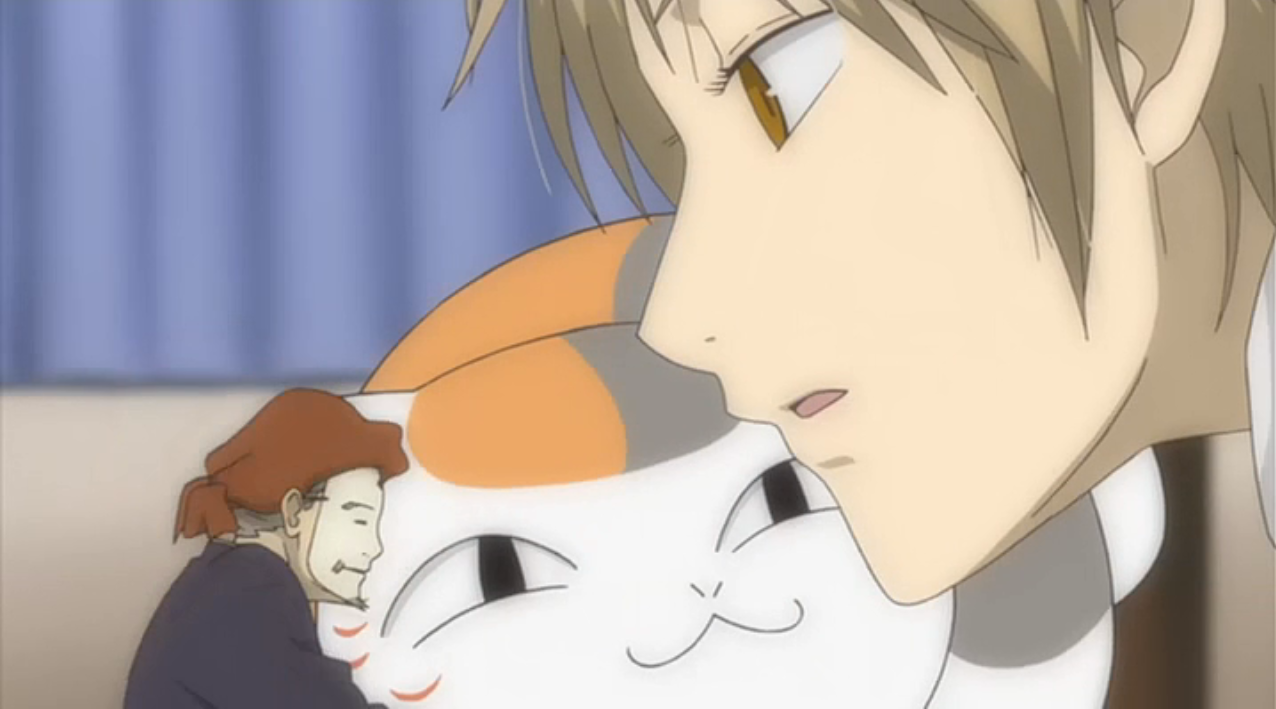
A youkai, Nyanko-sensei, and Natsume in the second episode.
This youkai, like many others, has come to Natsume in order to get his
name back, which his grandmother had taken from him. In the process,
they become friends.
This change may be partially due to maturity. As might be expected, I grew a lot between my sixteenth winter and my twentieth. But at some point, I had to step outside my box and watch something with that drab "slow-paced" label. The show that did it for me was Natsume Yuujinchou.

I'd noticed Natsume Yuujinchou, or Natsume's Book of Friends, pop up as I browsed Crunchyroll and Anime-Planet. It was popular. The "fantasy" tag interested me, but the "episodic" and "slow-paced" tags turned me off. Still, as I recounted two years ago, I eventually gave in, and I loved it. I followed the fourth season as it aired.

While each episode had its own conflict, there is overarching character development and plot to give it continuity. Natsume is a high school student who has been passed among relatives since his parents died when he was young. He's endured rejection and loneliness for years, largely because he can see youkai, and no one else can. He's been called a liar and troublemaker, he's lost friends, and no family keeps him for long.

At the beginning of the show, Natsume moves in with a distantly related couple that is different than the others, more gracious and genuinely caring. Trust and a sense of family develop throughout the four seasons (or series, if you prefer, since they weren't aired consecutively). He makes friends with his schoolmates, and if they notice anything strange, they don't desert him over it. He stops running away from the youkai, finds out why he can see them, and makes friends with many of them. He learns about others who are lonely, and he learns that people do care for him. He is still in a very unique situation, but he is not alone.

The themes of loneliness and friendship have been important to me for a long time. I went through a lonely phase in high school, and twists in my thinking convinced me that no one needed my friendship, at least no one in the vicinity. I did, at least, have my mom to talk to, and I wrestled through things with God, but I still felt isolated. I don't think the feeling was at its worst when I watched Natsume Yuujinchou, but I still wasn't in great shape at the time. It was soothing to watch Natsume become less lonely.

There were other things I enjoyed, of course. Shintoism plays a key role in the set, premise, and characters, so that is fascinating to watch. Nyanko-sensei, known to most youkai as Madara, is an amusing character, and impressive in his full youkai form. Further, it's always fun to build vocabulary, and, as you may have noticed, "youkai" now flows easily off my tongue or keyboard. [Come to think of it, I should probably put that in my glossary. My understanding is still limited, so I struggle to find an appropriate English word. Perhaps "spirits" will do for now. The Japanese word just holds so much more richness, as "youkai" has the proper connotations, and "spirits" has other, Westernized connotations.]

When I think of peaceful anime, Natsume Yuujinchou is often the second to come to mind, after My Neighbor Totoro. It's interesting to realize the prevalence of Shinto elements in both of them. I have not done enough research to say much more on the religion, but these anime remind me to appreciate the little things in life and nature. They help me to slow down, take deep breaths, and smile. My perspective is different than the one in these anime. When I watch the wind ruffle branches or birds hopping along the ground, I see beauty created by a loving and present Creator. Still, there's no denying that Natsume Yuujinchou and the other shows got something right, and it's a delight to take part in it.

Friday, December 27, 2013

Rewind: The Wallflower

Last time I wrote about The Wallflower, almost three years ago, it resulted in a reflective post. I've had a few years to reflect on the same topics and add to my thoughts. Those years show in this post, so it's a little more in depth than past "Rewind" posts.

It’s been a while since I watched or read The Wallflower (Yamato Nadeshiko Shichi Henge). But I’ve thought about it now and then, attempted to watch the dubbed version, and reread my old post on the series. It’s easy to remember the premise, and easier still to remember the appeal of it. I identified with the main character, Sunako. I wanted friends to reach out to me like the boys in The Wallflower reached out to her. I wanted to be special to a group of people, and perhaps especially special to a single young man, like Sunako was. I enjoyed the light romance, and the characters’ more charming moments made me giggle. The Wallflower gave me - and millions of other girls - a way to live a fantasy. Yes, it was unrealistic. Still, it addressed real needs: the need for acceptance, companionship, love, to be pursued. In its own way, The Wallflower addressed our need for salvation from ourselves and the darkness that encompasses us.

Sunako is a high school girl who loves horror. She spends her days hiding in her dark room, watching horror movies. When she must leave the safety of her room, she hides behind her long hair. She does not put care into her appearance. Her clothes are frumpy, and her skin could benefit from basic care. She carries the pain of rejection with her; two years ago, the boy she liked called her ugly. Even before that, she wasn’t exactly a social butterfly. Now, it’s yet another reason to stay in the shadows.
Her rich, traveling aunt wants to change her. She sends Sunako to live in her mansion with four stunningly handsome boys. In exchange for free rent, they are instructed to transform her into a beautiful lady. They don’t have much to work with. Sunako is not a willing subject, and if she looks directly at her housemates, she gets a nose bleed, as she does around all such “beautiful creatures.” She would prefer to stay in darkness with her horror movies and skulls. These habits have shaped her demeanor, so she actually scares the guys. Like her aunt, they'd much rather change her into something more "ladylike" than accept her for who she is, horror movies and all.

The young men, also students at her high school, are determined. At first, they try to draw her out of darkness because they want free rent. This turns into genuine care. They don’t all compete for her love. Unlike characters in certain recent reverse harem anime, these boys have somewhat varied tastes in women (and some sense of respect). But they become her friends and defenders. One of them becomes the key love interest.

One of the "ridiculous things" I'm referring
to. This particular adventure is in ep 3.
It’s a gradual process, and many ridiculous things happen along the way. I used anime and manga to escape reality much like Sunako used horror, so I enjoyed the unrealistic scenarios and the laughs they produced. This brand of shoujo romantic comedy held particular appeal at the time - by the end of 2010, I’d also watched Skip Beat, Fruits Basket, Kare Kano, Itazura na Kiss, and similar shows. They transported me to a different reality, a place where unlikely love bloomed between unlikely people in even more unlikely situations. I considered myself an extremely unlikely candidate for anything close to romance. I craved the kind of excitement and attention shoujo heroines experienced. I liked anime where the girl was stuck living with the guys, because she automatically got their notice and companionship. I escaped into the anime and lived through the characters, because by the end of 2010, my anxiety and depression were starting to suffocate me again. I wanted someone to notice, to save me from the downward spiral, to draw me into the light even if I resisted.

Of course, I’m not a shoujo heroine, so only my family, psychiatrist, and God seemed to realize my situation. Faced with that reality, I settled for watching Kyohei draw near to Sunako. I knew that wasn’t sufficient for me. Here’s an excerpt of what I posted on February 4, 2011:

“Why then do I forget Him? I read manga, watch anime, and dream of young gentlemen to fill a prince-shaped hole. Yet Jesus already came to fill that hole, and I already accepted Him for the divine Prince He is. Do I, deep down, not truly believe that He is enough? Does some part of me think I need to prove myself worthy of His love? Jesus’ radiance outshines that of any manga or anime character. I don’t get a bloody nose when I realize His presence, but I do get overwhelmed. He is far more than a hundred times as great as Kyohei, Tankenaga, or any other character in The Wallflower. In comparison, I feel like Sunako in her most diminutive form. Part of me wants to hide in my room, turn off the lights, and escape into an anime the way Sunako does with her horror movies. But the other part of me wants to venture into that brilliant light, brave my “bloody nose,” and find out more about the dazzling Prince who gave up everything for me, who pursues a relationship with scattered little me.”

I felt helpless at that point. I knew the truth of what I wrote - Jesus was sufficient. He loved me. I held onto those facts and tried not to let escape define every moment of my free time, tried not to ignore Him, tried to rely on Him. But it would be two more months before I reached my turning point, and several more months before the heavy-heartedness was gone.

I am grateful for my time in darkness. I’m glad it wasn’t worse, but I’m also glad it wasn’t easier. My obsessive attempts to use anime as an escape, my attempts to hide those wasted hours and late nights from my parents and those who I thought lived in light, my attempts to sort out my feelings and live more organized, more productive, more like the other, “healthy” kids - these showed me my helplessness, my brokenness, my weakness, my sinfulness.

By the time I graduated from high school, by the time I took a year off to heal, I was a little mroe humble. My relationship with Jesus had weathered the storms of teenage-hood, thanks to His faithfulness. I grasped Him desperately with my eyes squeezed shut, and He held me securely in His arms. And I came out of it with a better idea of how much I needed salvation, not just from eternal punishment, but from the weight of sin and brokenness everyday.

Sunako and the boys. I think we see their
comedic/diminuitive expressions more
often than their normal facial features.
I love watching anime characters pursue each other. In The Wallflower, Kyouhei and the others pursue Sunako, showing her that the light isn’t so bad. And when the shoe’s on the other foot, when Kyouhei is kidnapped or runs away, Sunako pursues him. I’ve discovered something pretty cool about reality, though: Jesus didn’t stop pursuing me when I became a Christian. He didn’t say, “okay, my work here is done. Time to pursue the next lost sheep.” When I stray, He comes and pulls me back to Him. I’ve learned, and continue to learn, to trust His passionate, pursuing love. I trust Him with my imperfections, trust Him to know those imperfections better than I do and still love me more than I can imagine. So I try not to hide from His light when I’m faced with my brokenness. He sees it anyway, and He’s able to heal me, to work with me, to use that brokenness for something beautiful. I’ve seen some of that already. He has filled every need that I felt addressed in The Wallflower, and He does so in a way that no one else can - not in real life, and certainly not in a fictional animated story. 

Now, I’m going to stop writing. “Rewind” posts are supposed to be short bits about shows I barely remember. Well, this post is about The Wallflower, but it’s also about things that have been on my mind in the three years since I first watched it. I could go on (in fact, I have), but I’ll save it for another post.

Sunday, November 10, 2013

Dear Extroverted Friends

Dear Extroverted Friends,

We're different.

"Well, duh," you say. "I like parties, and you don't."

First, that's not completely accurate. Believe it or not, I enjoy some parties. At weddings, for example, I'm always on the dance floor until Dad wants to go home. I just can't go to parties/big gatherings/social things as often as you can.

Second, you're both over-simplifying and making a big generalization. That's okay. Introverts do the same thing. In fact, some of you extroverts might be complaining, "Hey! We don't all like parties! I do other social stuff instead!"

There are a few comics and such floating around about introverts and extroverts. They're fun. Maybe they've opened your eyes a little. Now, I want to throw my two cents in.

I'm going to be frank. If you know me, then please understand, none of this is out of resentment or annoyance with you. Those of you who are close enough to get on my nerves usually don't. You're too caring and too understanding of my needs. Thank you. Hopefully this will help you understand better... even if all you understand is that you can't completely understand me. That's okay, too.

This is not meant to be a generalization about all introverts. We have different personalities and struggles, and I've had anxiety issues that make my introversion a little more pronounced at times.

Here's the thing about being introverted: it's not a choice. It's just how some of us are. I simply cannot handle being too social too often. If I am, I'll crack. My energy and mental health will start to leak out of that crack. Sometimes, I notice I've cracked, but I don't retreat from people the way I need to. The crack widens. If I'm not careful, I may breakdown entirely. I try to avoid that. It takes a long time to put the pieces back together.

There are days when I want to hang out, but I know I'm nearing my breaking point. I have to turn you down. I appreciate the invitation, though - I really do.

If I must be around friends or family when I'm already cracking, it does help if we ignore each other. But it's not just quietness that I need. It's solitude. A quiet presence is still a presence. I appreciate your offer to just be quiet around me. Yet, if I'm at my breaking point, then I don't want to hear you, smell you, see you, feel you, or even sense you.

"What's wrong?" you might ask.

Nothing's wrong. I'm not upset about anything. You haven't done anything to hurt or offend me. Nor has anyone else.  I'm just worn out. No, I do not want a hug! Don't touch me! I need space. Sometimes, I love hugs. But when I'm running on empty like this, I can't be in such close proximity with anyone. There are times I won't even let my mom hug me. So if you try, I'll probably snap. I might even hiss like a cornered cat. Please don't try. I don't want to hurt you like that. If you really want to hug me when I'm upset, then stand at a safe distance and ask first.

Talking about it won't help, either. This isn't the kind of problem that's helped by talking or any other kind of human interaction. I love you, my friend, but I need to be alone. So either go away or let me retreat into my hole.

Please, don't feel bad if you've interrupted my solitude when I was cracking. You didn't know any better. I don't want you to feel bad for your extroverted perspective. And my introversion doesn't give me a right to hurt you. So if I snap at you or otherwise hurt your feelings when I'm running on empty, please confront me. I will apologize, and I will work to make sure my problem doesn't become your problem.

Also, please understand that I'm still learning about the needs of my non-introvert friends. I care for you, but I don't always realize that you need a hug or conversation or even just a presence. Plus, there's more to you than your extroversion, which make it even harder to know what you need. So, as we get to know each other, be honest. Extroverts and introverts may appear to be different species, but I'm confident we can live in harmony. In fact, we have to. I need your help navigating the social world and getting information out. Maybe there's something I can help you out with, too... when I'm not hiding in my hole, that is.

Love,
Your Introverted Friend

Sunday, August 25, 2013

Advice from Anime: Join a Club

Clubs are a powerful presence in school anime. Some creators use clubs as an excuse for a harem or borderline harem anime. Those have little appeal to me, but even school club anime without a polarized male-female ratio don't always keep my interest. And then there are anime like Chihayafuru, which wouldn't be the treasures they are without their clubs.

All of these school club anime, mediocre and excellent alike, get one thing right: clubs are a great way to meet people. Thus, if I can give one piece advice to incoming college freshmen, it's this: join a club.

I never thought I'd say something like that. I never thought that I would join a club in college. I was sure that school, work, and required hall activities would be all my introverted self could handle. I'm the type who can go weeks without seeing another human being and be perfectly happy. I might enjoy social activities on occasion, but, as a general rule, I need to spend at least twice as much time by myself to recover from social events. When it's really bad, I can't even handle Twitter or Facebook.

Yet even introverts get lonely. When my roommates moved out before second semester, I decided that I'd be purposeful about socializing and making friends. I still didn't plan on joining a club, though. I did not want that kind of commitment. In fact, when a professor suggested that I join a club to meet people, I politely and firmly told him that there was no way I'd have the time and energy for such activities.

Not long after the start of spring semester, a classmate came up to me and said she was going to start a pro-life club. She needed some founding members and officers. I thought and prayed about it for a few days before agreeing to join. Before I knew it, I wasn't just part of a club. I was signing paperwork, agreeing to be the club's vice president! I was the right hand woman. When the president wasn't around, people looked to me for answers. This decision surprised me, my family, and probably some of my hallmates.

Okay, so our club's  not quite all hugs and sparkles like
this scene from Chihayafuru 2. But we're friends, which
is more than we were a year ago.
It was a surprise, but it was a good surprise. I made friends I wouldn't have made otherwise. As a task-oriented, sometimes shy, introverted girl, I find that working alongside someone is a safe, low-stress way to get to know them. And, just like in anime, the founding club members started to hang out outside of club meetings. We went to see a play. We ate together at the dining hall after meetings. The founding president gave me tea and honey when I had a bad cold. Three of us went to a summit put on by the nationwide Students for Life organization. We laughed, talked, and learned together. It was a shorter and less intense trip than the club training trips in Eyeshield 21 or the tournaments in Chihayafuru, and only a few of us were able to go. Yet it was enough for me to experience some of the same bonding that's present in my favorite club anime.

I was surprised by what I could handle. I often acted more like the club secretary than a vice president (and I'm relieved to report that this semester, I am the secretary). Yet I still had a leadership position. I led our club meeting when the president was sick. I was committed to both the general club meetings and short planning sessions. And none of this caused an emotional breakdown. This might seem like small stuff from the outside. To me, it was an incredible step.

In anime, clubs are often used to make self-conscious or loner characters open up and loosen up. People who would never meet become friends. Bookworms and athletes, Type-A students and slackers, class clowns and the painfully shy: all are joined together by one shared interest or goal. I used to think that clubs were for extroverts. Now, I'd almost argue the opposite: clubs are just what introverts like me need to get our healthy dose of purposeful socialization.

So, freshmen, here's a tip: join a club. Participate in a sport, whether you're on the school team or playing intramurals. Help put on a play. Join a small group or Bible study. Find some sort of activity or organization that you'd like to be a part of, and be open to personal growth and new friendship. Dare to step outside your comfort zone. You just might find that it's not so uncomfortable out there after all.

Thursday, August 1, 2013

Rewind: Gungrave

My family and I are busy right now, but stress, thankfully, seems low at the moment. I was able to take a few minutes away for my third weekly Rewind post. I picked one that I knew I had screenshots for, in an attempt to cut down time.

On Anime-Planet, I have two custom anime lists that I keep up to date. One includes all the anime I've completed more than once. There are thirteen titles on that list. The other, entitled "Anime I Continue to Rave About (all time faves)," has only two titles.

Gungrave is on both of those lists. I've seen it three times, and I recommend it to my friends. My mom has often heard me rave about it. Maybe I haven't blogged about it because I talk about it all the time anyway. I've even mentioned it in my journal. Yet it seems incredibly unfair that so many other anime have been featured in posts, and Gungrave, one of only two anime to be named an all time favorite, doesn't even have a tag on my blog yet.

It doesn't matter. I only have a little time left. Let's get to the important part: what makes Gungrave so great.

I could just tell you that it's an action drama about the mafia. I could also refer you to the Anime-Planet description and sothis's review. But none of that would tell you what I love about this show.

Harry and Brandon are the two on the right in this
picture of their gang. 
Sure, the action is great. I like the guns and the fights. And, of course, anything involving the mafia ought to be intriguing.

Still, the guns, the mafia, and the setting, prominent as they are, don't make the anime. The characters and relationships capture my heart and drive the plot. The main character, Brandon Heat, is especially dear to me. For a street rat turned mafia enforcer turned... something else.... he has a heart of gold, and the values to match.

Brandon and his best friend, Harry MacDowel, met in the orphanage when they were young kids. The orphanage was hard, and life after they left wasn't much easier. They grew up in a neighborhood where bullet holes were a more common decoration than flowers. Yet it was their home.

After the first episode, which flashes ahead in the story, we meet Brandon and Harry at the beginning of adulthood. I'd put them around 18 years old. They've formed a family of sorts with three other kids, and they live simple lives of small crime, fights, and friendship. We follow Brandon and Harry for the next couple decades of their lives, watching them grow. Their deep friendship encounters twists and turns, and seems to fail at a certain time, yet the heart connection remains.

Of the two men, Brandon is the one who holds most selflessly to the friendship. He is fiercely loyal to those he counts as friends, especially Harry. He's like a shadow next to his friend, especially at first, but he's also the last one you'd want to fight. He's quiet, but not timid. He's not expressive with his emotions, but he feels deeply. His love, for friend and sweetheart alike, is selfless and true. The ones whom he loves tear his heart apart, yet he does not resent them. Nor does he harden his heart, nor abandon them to save himself from further hurt.

It's not blind love, nor even enabling love. When his friends go the wrong way, Brandon takes it upon himself to make thing right, even if it kills him... even after it kills him.
Brandon in episode 24, still sweet as ever, but with
a much bigger burden than he had in that other picture.

I'm running out of time, but let me say this: there is a lot of action. Fistfights, gunfights, amazingly fitting science fiction action, chases, duels, assassination... the list goes on. It's all exciting and well executed. Most importantly, to me anyway, the action scenes are expressions of who the characters are, and building blocks for who the characters become.

I spent a little bit of time on Brandon in this post, and I still didn't cover everything that makes him so awesome. He's not alone; almost all the characters are wonderfully developed. It's amazing to watch their mental, emotional, and physical development. For example, one of the secondary characters slowly grows from a friendly, skinny young man to a very fat, upset, dangerous man. We know why he's fat, too; we've watched him consume fried chicken almost constantly. His physical changes exemplify the changes we watch in other characters. There's an important one who becomes twisted and villainous. Yet I still love him, because I know who he was, and who he could be if he made different choices.

Agh! I must stop now. I should have known it was a bad idea to write Gungrave when I don't have a lot of time on my hands. I could make this post twice as long and still have more good to say. There is one character, maybe two, that annoyed me, but even she had her place in the story. The show is at least 98% awesome, so I can overlook her negative traits.

Tuesday, July 9, 2013

Chihayafuru 2, Friendship Changes, and Finishing Thoughts


[Some small spoilers ahead - nothing about who wins/loses any matches, though]


Chihayafuru 2 is over. It’s been over for a week an a half, but I’ve finally finished episode 25.

I love this show. 

The suspense of karuta tournaments, the lovely art, the good pacing, and the entertaining characters would keep me hooked no matter what. Yet Chihayafuru does more than entertain me. It draws out an empathy that I feel with very few other shows. Part of me doesn’t like the attachment I feel to the characters and their relationships, because it makes my heart hurt a little.

Chihaya shares a bond with two dear childhood friends: Taichi and Arata. Over the years, they’ve gone their separate ways. Arata only lived nearby for a short time in elementary school before he moved back to Fukui, but he is the one who ignited Chihaya’s passion for karuta. Because of that, he’s secured a special place in her heart. Taichi was never truly far away. He went to a different middle school than Chihaya, but when they reunite in high school, it’s clear that he still feels deeply connected to her, and not just because they played karuta together.

Each of the three see their bond in a slightly different light: 

Flashback to the good old days of
Chihaya and Arata's early matches.
Chihaya holds tightly to their connection through karuta. She has a passion not only for the game, but for the people she shares it with, especially Arata and Taichi. The game bonded them when they were little, and now it draws them back together. Arata is the goal Chihaya reaches for as a karuta player. In the end of the most recent series, it appears her heart has begun to go even further, as she muses, “For the rest of my life, I’ll always love karuta, and I’ll always love Arata.” I’m not sure if she means love love, or if she even knows what she means, but something’s there.

To Arata, the days he spent with Chihaya and Taichi are sweet memories. It is clear that, despite the distance, and despite the long periods of time without contact, he holds them dear. He would love to play on a team with them again, and he visualizes his matches with Chihaya to put himself in the zone when he plays competitive karuta.

Episode 20, Taichi and Arata
Taichi’s feelings aren’t so simple. He loves karuta, but it is not the only thing on his mind. He cares for Chihaya as more than a friend or teammate. Because of that, Arata isn’t just a childhood friend or a friendly rival. In Taichi’s mind, it’s not just karuta that’s on the table: it’s Chihaya’s heart. In fact, in episode 20 of Chihayafuru 2, Taichi says to his back, “You are my enemy.” Arata doesn’t hear the quiet words. In fact, Arata seems almost as oblivious as Chihaya to the whole thing. But I heard it clearly, and it made me a bit sad.

If I think back, I remember that Taichi wasn’t all that fond of Arata when they were young; he seemed to fake it to make Chihaya happy. Still, I, like Chihaya, wanted the friendship to be real and lasting.

I’m a loyal person. Once I decide someone is important to me, they stay important to me forever. Our paths may part. We may move away and find other interests. Yet, no matter how far apart we wander, that person will always have a place in my heart and home. 

Since I feel my attachments so deeply, I can’t help but project the same feelings onto Chihaya and her friendships. I long for peace among the three. I want them to play karuta together again, both on a team and as friendly rivals. I want Chihaya to remain ignorant of the ways of the heart, and I want Taichi’s heart to be at peace. I want to know where Arata’s heart is. I just want them all to be okay.

The reality is that friendships change. I’m afraid that, someday, Chihaya will have to let go of the bond she thought they all felt. That will be hard. I haven’t had to deal with romance, but I’ve had to make my peace with changing friendship. It hurt, even though the change had nothing to do with negative interactions or fights. Yet I’m okay. I know that Chihaya, Taichi, and Arata will be okay someday to, but I’m afraid that at least one of them will feel lonely.

Chihaya and Taichi at the end of
episode 25, moving forward, eyes
on the future.
I keep trying to think of a way for things to turn out positively for the three. Maybe if Chihaya outgrows her infatuation with Arata, she and Taichi will eventually become a couple. I think they’d be great together. I don’t know where Arata’s heart is, but maybe he will eventually find someone, too, someone who will join Chihaya in strengthening the bonds even as they change. First, though, I think the three need to make peace with their childhood friendship and what it means for their current relationship. Maybe they’ll be able to do that the next time they meet karuta tournament. I hope so.

But does it matter what I hope? Aren’t I powerless in the face of the original mangaka’s work? All I can do is re-watch old episodes and wait for Chihayafuru 3 to come out. Because there must be another season coming eventually, right? Sure, nothing’s planned yet, but no halfway decent studio could leave us hanging like this, at least not without someone having a guilty conscience... right? Yeah, sure, I could always switch to the manga if I got too desperate, but still... No matter. Time to move on. I’ve got novels to read, Spring anime to finish, and life to live. I refuse to hang my happiness on a single anime, even one so good as Chihayafuru

Wednesday, June 19, 2013

Bittersweet Nabari no Ou: Depression and Friendship


Yoite and Miharu
[Warning: Spoilers ahead]

Throughout Nabari no Ou, one fact rings clear to me: Yoite is depressed. I ache for him as he wishes to be erased from the world. He does not consider himself alive or dead. He does not feel wanted or loved. He doesn’t want to die, but he doesn’t want to live either. 

Hattori, chief of the Kairoshu, exploits Yoite’s depression. Instead of encouraging the youth to live, he promises a brand of “disappearance” - death by use of kira. The kid needs help, and not the kind of “help” that drains his life, but Hattori doesn’t care.

Others do care. First Yukimi and his sister, then Miharo, then Gau and Kaito and others. They begin to watch over Yoite and care deeply for him, but he is too deep in his depression to see it until Miharo spells it out for him in the last episode. Only then does he choose to live out the time he has left.

That is what people need when they are depressed. Whether they are suicidal or simply want to wish life away, they need people to care about them, and for that care to be made clear. Repeatedly and honestly. They need people who will be patient and stand by them, who will not give them an excuse to wallow in depression, but a hand to climb out of it, however long it may take. 

I know this from my own struggles. When you’re depressed, your thinking becomes twisted. You don’t see things in perspective. I never considered taking my own life, likely because, unlike Yoite, I had a foundation of love and trust to stand on. But I did wish I didn’t have to live. I wouldn’t have minded simply being erased. That wasn’t an option, so I stumbled along, holding tight to God’s love and to my parents’ hands, to my “Miharu”s, and to the promise that somehow my troubles would be used for good. 

There was good on the other side. It was a slow process to get there, but it was good. I wouldn’t trade any part of my journey, even if I’d be more successful in life without it. Like Yoite says, “It’s because of my past that I am who I am now.” Our pasts make us who we are to ourselves and to those around us. We might be ashamed of our pasts, and the consequences may haunt us, but who would we be without them?

I know that my past struggles with anxiety and depression, struggles that I’m still on the alert for in case they come back, made me more compassionate. I look at the world differently, with more understanding, and my sharp tongue is a little softer than before. Further, if I didn’t encounter the depression cycle in high school, I’d probably encounter it later in life, when I have more responsibilities. Now, I know the signs, and hopefully I can avoid the spiral.

Part of avoiding the depression spiral is to surround myself with the right people. A few years ago, I’d have said that the right people meant no people; I just needed my computer and the lock on my door. But I’ve discovered that, sometimes, friends are just what I need to keep my melancholy mood from becoming something more. They keep me from wishing the world away again, much as Miharu helps Yoite embrace his life.

Yoite is dying because he used kira, and he has blood on his hands because of the kira, too. But he won’t trade it in. Ironically, the very thing that was meant to make him disappear, the thing Hattori would use for his twisted plans, was used to give Yoite friends. Ultimately, the kira technique obtained because of depression brought him out of depression. It was used for good. I applaud the mangaka for that.

And I applaud my Lord, the Mangaka of my life, for the beautiful work He is using my struggles for. I barely see bits and pieces of it, but what I see fills my heart with praise. The pain brought on by sinful, broken flesh is being used for good, just like Romans 8:28 says.

Painful memories are used to create something good; that’s a theme in Nabari no Ou, stated in various ways in the last episode. What is bitter somehow becomes sweet. 

I was drawn to this show first because of the action, then the humor in character interactions. I don’t know how deeply I felt it the first time I watched, over three years ago, but now, it feels like I’m saying goodbye to Yoite for the first time. There was so much bitterness in Yoite’s past - in most of the characters’ pasts, really - yet by the end, it is sweet. Depression becomes peace and joy, even in the sadness of an ending life. 

It is a transition made possible by friendship. The theme can seem overdone when you’ve watched a lot of anime (or shows from any country, really). But as Nabari no Ou demonstrates, the connections between people are serious... serious, and beautiful, and, sometimes, what stands between life and death. 

We were not made to live life alone. Remember that. If you are feeling down, whether or not you think it’s diagnosable depression, or if the feelings that I described resonate within you, find someone to be with or talk to: a friend, relative, counselor - you can even drop me a comment or a tweet. And if you see someone feeling down, say hello. Offer a smile, a hug, or whatever is needed. Ask if you don’t know. Take suicide signs seriously (Google those if in doubt - I’m not an expert on it). 

As Yoite, Miharu, and the rest of the cast of Nabari no Ou illustrate so well, together, we can take the pain and bitterness and make something sweet.