This week, I've decided to tag team with my [recent] past self to write about
Clannad. Thus, I'm doing two new things with this Rewind post. First, I'm writing about something that I watched relatively recently, instead of something from over a year ago. Second, I'm embedding my tweets, so if you missed my journey through
Clannad on Twitter the first time around, you can see it now - this time, with commentary and screenshots.
*Edit: Spoiler Warning! I'd say one big spoiler, but if you've managed to avoid that spoiler and still hang out around fans, you have amazing luck. There's one medium spoiler, I think, and several tiny ones.*
For those of you who don't know, fluffy pink cherry trees and their falling petals are a common part of drama and slice-of-life type anime. I read somewhere that they symbolize change, as in the changing seasons of life. They can be a powerful foreshadowing tool... or they can be a trope. I tried to keep an open mind, but my first assumption in this
Clannad scene was "trope," especially with the brooding student on his way to begin a new school year. I had no idea that this time, the cherry blossoms really did mean something.
This wasn't the first time I'd tried
Clannad. In the past, I judged the show within the first episode, dismissing it as cliche and boring. But Charles at Beneath the Tangles praised
Clannad and its sequel series in multiple posts (
this one was probably the final straw),
Anime-Planet users rated it generously, and
Silvachief and other gamers had positive things to say about the visual novels the anime was based on. Plus, as you may remember from
last week's Rewind post, I'm a changed woman since
Natsume Yuujinchou. I've learned to be patient and accept anime of almost all shapes and sizes. So, this time around, I persevered through the first couple episodes. At first, the only redeeming quality I could find was the ending theme, a cute song called "Dango Daikazoku." I liked it even before I heard the words to it, when I listened to Japesland's
saxophone cover on YouTube.
But seriously, those girls' eyes... they're huge and unnaturally shaped. It took several episodes to get used to them.
When I look back on
Clannad, I immediately think of it as precious. I already forgot how long it took before I no longer had to tell myself to keep an open mind. At first, it was just the comedic moments that caught my interest. Nothing important seemed to be happening story-wise. I didn't realize that I'd sprung the director's trap, and he was pulling in my heart, tying it to the characters one smile and chuckle at a time.
Fuko-chan is the most blatant of the subdued supernatural elements in
Clannad. In fact, she's one of the elements that reminds me
Clannad was a visual novel before it was an anime. What romantic visual novel or dating sim is complete without a supernatural and/or moe character? Not, of course, that I'm an expert on the topic. I've only played a few free otome games, read related blogs, and watched a couple anime based on visual novels. But that's beside the point.
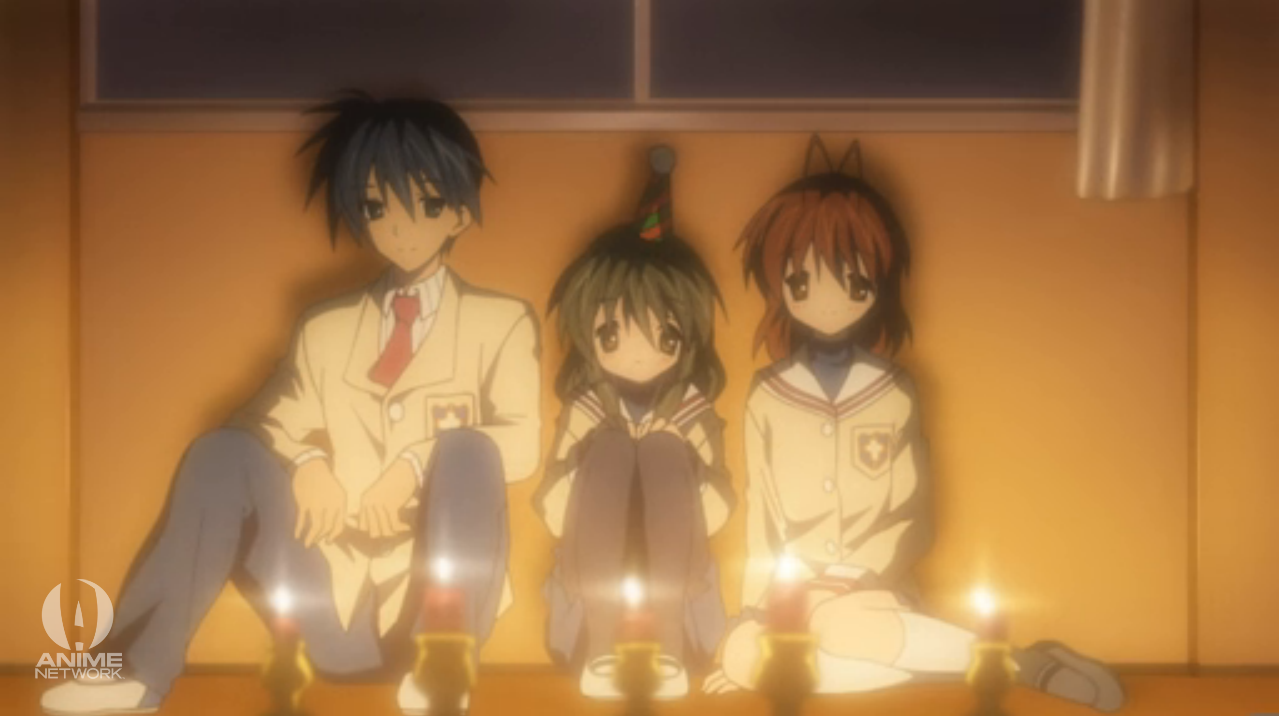 |
Tomoya, Fuko, and Nagisa in the touching ninth episode. A
warning: if this episode makes you cry, like it has many others,
you'll want to make sure you're stocked up on Kleenex before you
get to the sequel series. |
For that matter, Fuko is almost beside the point, too. After all, the anime follows the Nagisa route - that is, the story visual novel players enjoy as they make choices (as the main character, Tomoya) leading to a relationship with Nagisa instead of one of the other girls. However, the Fuko arc of the anime does turn out to be important for Tomoya and Nagisa. The two slowly grow closer as they help Fuko pass out starfish. She's the same age as Tomoya, but she serves the same kind of purpose that many young characters do: both her insight into their relationship and her childlike neediness propel the two toward one another. In fact, she's the reason Tomoya began calling Nagisa by her first name.
Kotomi-chan fulfills the genius and childhood friend quota in this harem anime. I didn't know she took care of the childhood friend quota until partially through the anime (so I apologize for the spoiler if you haven't seen this). Still, I assumed she was just a stock character. Granted, she didn't turn out to be incredibly unique, but her story was told rather well, further destroying my original assumption that
Clannad was just another harem anime. [Just in case you think I'm slamming the harem genre, I want to remind you that I once considered
The Wallflower to be a favorite anime, and I actively sought out reverse harem shows. I'm pretty much out of that phase, but I'm still very much in a glass house, and I'm not going throw stones at the harem genre... just the mediocre anime in the genre.]
I didn't tweet about
Clannad again for weeks, partially because other anime and homework consumed my time. My next prolonged
Clannad viewing session came while I was making Christmas cookies, so my hands were too covered in flour, dough, and frosting to Tweet. I'm glad I didn't finish the show all at once. Often, watching a show over the space of several days, weeks, or even months gives me a chance to marinate in it as the story and art imprints a precious memory in my mind. Such was the case with
Clannad. I've seen many an animated teenager confess his love, but never has the moment been as moving and important to me as in this show.
Clannad built the setting and characters that allowed it and its sequel,
Clannad After Story, to stand tall. By the heartwarming end, I was emotionally invested in Tomoya and Nagisa's relationship, and I cared for the other characters as well. The last couple episodes warmed my heart, but left me with questions about Tomoya's father, the characters' futures, and, of course, that otherworldly side story with the girl and scrap-heap-metal-doll-thing.
Clannad was just the foundation. As I'd been promised, its sequel surpassed it almost every way. But more on that next week.


