Showing posts with label linguistics. Show all posts

Wednesday, June 10, 2015

Summer Reading: The Professor and the Madman (ch. 1-2)

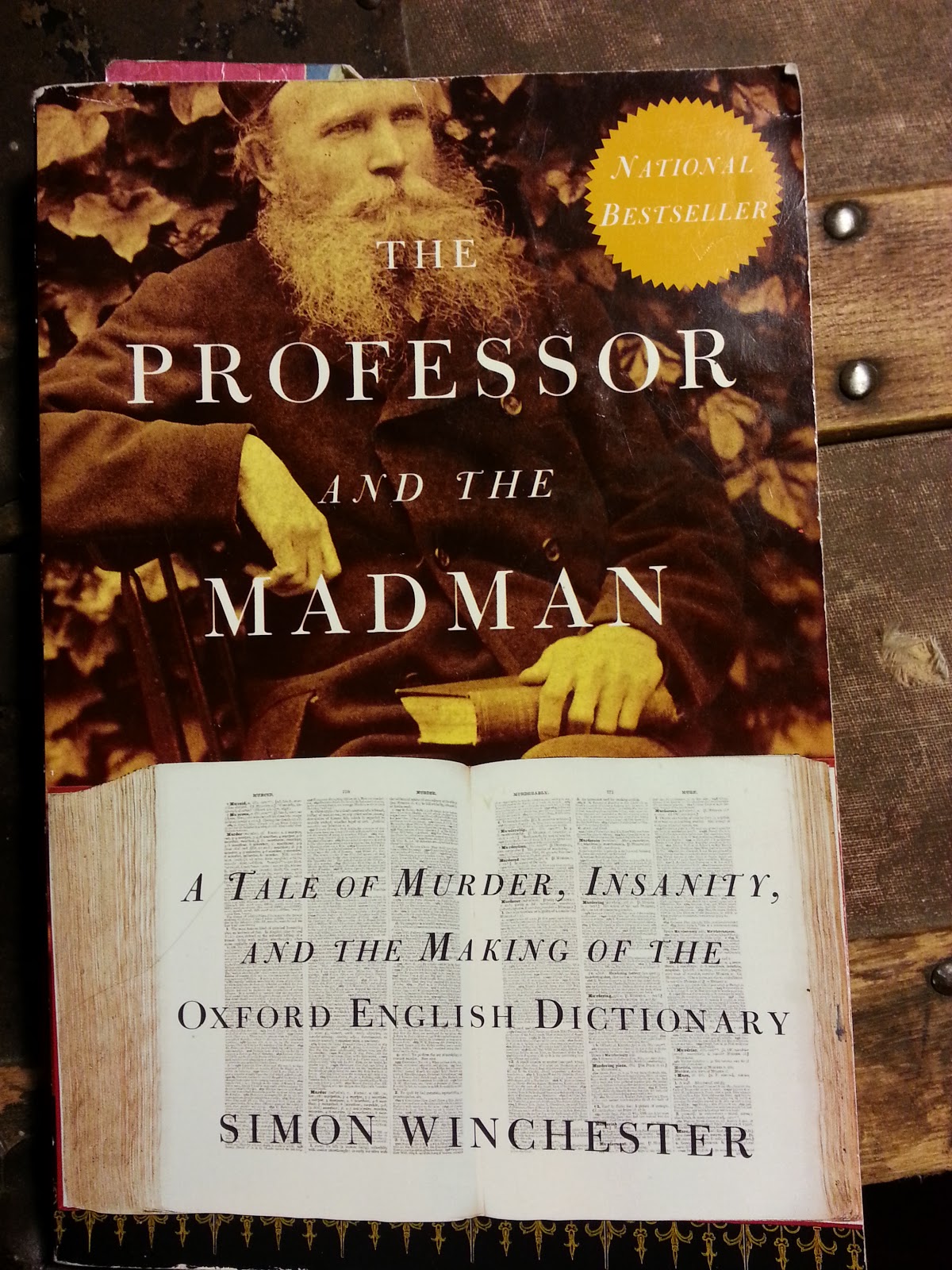
I've been volunteering in a thrift store's book section. Amazingly, I've only bought two three books (the number changed after I started this post) and brought home several free ones. One of them is The Professor and the Madman: A Tale of Murder, Insanity, and the Making of the Oxford English Dictionary by Simon Winchester. Can you guess which part of the title caught my attention? Here's a hint: I'm an English major.

I think Winchester has spent too much time reading the Oxford English Dictionary (referred to as the OED from here on out), because he uses a lot of unfamiliar words. Seriously. I've been reading on the college level since long before college, and I do as much of the assigned reading as possible. My vocabulary isn't shabby. But Winchester throws in words like "louche" and "garroting" like everyone should know them.

louche: disreputable or sordid in a rakishly appealing way

garroting: present participle of "garrote," meaning to kill someone by strangulation, typically with a wire, cord, or iron collar

I've only read two chapters so far. The first begins with an excerpt of the OED's entry for "murder." It covers the incident that landed Dr. WC Minor in an asylum for the criminally insane. The second chapter has two epigraphs, excerpted from the entries for polymath ("A person of much or varied learning; one acquainted with various subjects of study") and philology ("Love of learning and literature; the study of literature, in a wide sense, including grammar, literary criticism and interpretation, the relation of literature and written records to history, etc.; literary or classical scholarship; polite learning"). This chapter focuses on Professor James Murray's life before his work as the lead editor of the OED. Murray didn't have much of a formal education, but he loved learning... to call him a "polymath" who learned for the sake of "philology" is an understatement. He was a nerd. The book doesn't say "nerd," of course. But in today's lingo, that's the best way to describe him. He knew Latin, of course. But he varied from fluent to familiar with all the Romance languages, as well as Dutch, Flemish, German, Danish. And he was quite capable in the realm of Anglo-Saxon and Moeso-Gothic as well. All that before he got higher education. If he lived 100 years later, I bet he'd be a Tolkien fan, fluent in Elvish and all derivatives, including the tongue of Mordor.

The second chapter also paused to recount the "protagonist" definition controversy. The OED said there could be multiple protagonists. In 1926, Fowler's Modern English Usage declared that "protagonist" could only be singular, and any instance of plural was absurd. The OED settled the matter over fifty years later, confirming that protagonist can, in fact, be pluralized. That's a relief, because The Professor and the Madman has two protagonists, as the title indicates.

I'm sensing that this author is a bit of a nerd, too. I'm a little out of my depth. It's like saying, "I'm a Naruto fan!" then meeting someone who knows a dozen jutsu hand signs and all the characters' names. Except with the English language.

This isn't as enjoyable as, say, a fantasy novel. But I still like it, and I'll keep puttering through it over the next week or two.

---
P.S.: I referenced the OED in two of last year's posts. I wrote about the origins of the words "geek" and "nerd." Thought it would be appropriate to link to those here, especially since they came from the homework assignment that introduced me to the OED.

Friday, July 18, 2014

Origins: Blogs (Part 3—Conversational Writing and Conclusion)

This is the last of a three-part series on the history and nature of blogs. In the first post, I wrote about blogs' early history and popularity growth. The second post included research from linguists (language scholars) about blogs' genres and grammar. This last section, excerpted and slightly modified from a research paper, covers the conversational elements of blogs before, and then concludes the series.

- - - 

Blogs are more personal and casual than most printed work. They are also more interactive, which is why many bloggers and academics refer to "conversation" in the blogosphere. Eric E. Peterson, a professor of Communication and Journalism at the University of Maine, finds this description troubling. He explores the topic in his 2011 article for Language@Internet, "How Conversational are Weblogs?" He acknowledges that bloggers often use a conversational tone, but cautions that the interactions on and between blogs do not truly constitute conversations. [Because, obviously, there is only one definition of "conversation," and we all know that the meanings of words are set in stone and never evolve at all… oh, wait.]

Unlike face-to-face conversations, blogs are non-linear and discontinuous in contact (Peterson). Responses to posts and comments are not immediate, and certainly not simultaneous. Bloggers write their posts uninterrupted by their audience's feedback, and if clarification is needed, it must happen across posts. Similarly, the context around posts is not immediate, but instead something that "both writers and readers must work to produce," usually by writing and reading serval posts over time.[I'd like to add that, in the aniblogosphere, our context grows with anime, other blogs and news sites, Twitter, and whatever else we share in our online experiences.]

While blog content is not a conversation, it is still conversational. Bloggers are writing to a large audience, but by using a conversational tone, they reach individuals in a more personal way. This attracts and keeps readers. It's not a new strategy, as Peterson points out. For decades, radio personalities have amassed listeners by speaking in a "for-anyone-as-someone" way, as if they were sitting down with each listener individually. Bloggers adopt an informal, frank style that readers perceive as "authentic, direct, and truthful" (Peterson). Of course, frankness, whether spoken or written, does not automatically confer honesty. But the popular perception remains. As a result, blogs attract millions of readers, many of whom feel a personal connection to their favorite, conversational bloggers.

The blogosphere has come a long way since the first online diaries of the 1990s. They vary widely in genre, purpose, and author. Blogs, though clearly a written form, have aspects of speech in their language. They are informal, even conversational, in style. They are not subject to the standardization process experienced by most published material, and their syntax and grammar reflects that.

- - -

So, there you have it. As bloggers and blog-readers, we're part of a form of communication so interesting, it's a topic of much conversation study and discussion among linguists. It took a while before they could all agree that the "blog" is a medium, not a genre. But even the slowest of them eventually arrived at that conclusion. And some of them think our often unconventional grammar is fascinating. Basically, they recognize that all of us in the blogosphere are part of something linguistically awesome. Or something like that. 

- - - 

Sources:
Peterson, Eric E. "How Conversational are Weblogs?." Language@Internet 8 (2011): n. pag. Web. <http://www.languageatinternet.org/articles/2011/Peterson>


Friday, July 4, 2014

Origins: Blogs (Part 2—Linguists, Genres, and Grammar)

Over a month ago, I posted about blogs' basic history. Most of the post was excerpted from a research paper I turned in last semester, called "The Linguistics of Blogs." You might want to check that out before reading this, but you don't have to. I'd like to share more of the same paper today. Did you know that, in the past, some linguists tried to shove blogs under the diary genre? I think that they all know better now. It's interesting to read their studies and articles—they think so hard about blogs, which I now consider to be a natural part of my life.

The rest is excerpted, with slight edits, from my essay.

- - - 

Blogs meld historical means of communication with modern technology. The result is unique, but some have still tried to fit it in more traditional categories. Many, especially in the blogosphere's early days, considered blogs to be a development of the personal diary. Laurie McNeill's 2005 article "Genre Under Construction: The Diary on the Internet" is based on the premise that blogs are "simply another kind or function of the diary genre, one particularly well-suited to contemporary diarists" (McNeill 6). Certainly, there are similarities. Like diaries, blogs have dated entries, which usually appear in chronological order. And many blogs do fit into the diary genre. In 2006, David Crystal wrote that the genre, which shows "a narrative account of events in a blogger's daily life… has been the fastest area of blog growth since 2001" (Language and the Internet 242).

However, blogs cannot be confined to a single genre. Crystal proposes a spectrum of blog purposes, with personal diaries on one end and corporate or institution-based blogs on the other end (Language and the Internet 240). Blogs can be written by one person or many, and some are run by companies. They may have no central theme, or they may focus on certain hobbies or political positions.

[At this point, most of you are probably thinking, "well, duh." But stick with me. A group of academics recently completed a study to prove that there are multiple blog genres… yes, it sounds like proving that  not all fruits are apples, but they took it very seriously. Read on.]

Last December, Dr. Alex Primo, Gabriela Zago, Erika Oikawa, and Gilberto Consoni of The Federal University of Rio Grande do Sul published a blog theme study in Discourse and Communication. In this study, they developed 36 subcategories of themes found in a sample of almost 7,000 posts. A few of the most common themes were technology, politics, mass media, and visual arts (352). The study only used Brazilian posts, but its broader conclusion applies across cultures in the blogosphere: blogs are more varied in theme than ever. "The online practice of self-expression" is no longer a sufficient model for explaining blogs. Further, "The view of blogs as a genre is also misleading, as it confuses medium and genres" (Primo et al. 355).

While blogs cannot be confined to any genre, the diary genre does show its linguistic freedom most clearly. Unlike traditionally printed work, blogs contain "freely written prose," untouched by standardization and editors. In his Internet Linguists: A Student Guide, David Crystal notes that syntax online is generally the same as offline, which some evolution according to the new mediums, or "outputs," as he calls them. He does, however, single out blogging as an output  where "some interesting syntactic developments could be taking place" (67). 

Crystal writes, "It is a syntax that reflects the way writers think and speak." Standard sentence divisions rarely come naturally in thoughts. Thus, "there is the unconstrained use of the dash to mark a change in the direction of thought, ellipses to show incompleteness, and the use of commas to mark pauses in rhythm" (68). At the same time, bloggers may leave out punctuation they consider unnecessary or troublesome, such as apostrophes. The grammar is unconventional, but present (69). A few similar styles appear in literature, such as James Joyce's stream of consciousness writing, but that is the limit. 

Even Joyce's work endured a level of editing and standardization. With blogs, however, there is no filter between author and reader except what they put there themselves. This kind of free, unmediated publication was normal in the Middle Ages, before standardization. In Language and the Internet, Crystal refers to "the spontaneous letter-writting of the late Middle Ages, for example, or some of the manuscript accounts of law-court proceedings…" Then, in the later part of the 1700s, grammar and usage manuals rose to power. These institutionalized "standard language," which became totalitarian "when publishers developed copy-editing procedures to ensure that their newspapers, magazines, and books conformed to an in-house style" (Language and the Internet 245). Of course, bloggers are not free from the influence of standardized English, and even the least conventional posts contain elements learned in school and recreational reading. And there are bloggers who "would be mortified if their text appeared in the blogosphere with a missing apostrophe" (246). Still, no matter what kind of grammar bloggers use, blogs, especially personal ones, stand separate from printed work in an important way: they are "a variety of writing intended for public consumption, which appears exactly as the author wrote it, which is not constrained by other genre conventions, and which privileges linguistic idiosyncrasy" (246). 

- - -

There's another small section of my blog linguistics paper, but this is enough for now. When I first researched this, I couldn't help but think of my own blogging habits, as well as some of the blogs I like to read. A lot of what Crystal said about ellipses and dashes is right on track. He didn't mention strikethrough, a formatting device that I've seen bloggers use for a humorous touch (or other purposes), and which is not replicable in spoken communication. But I can't expect his books to cover every cool way bloggers communicate. 

And so, another Origins post is finally done and posted. I hope you find this information at least half as interesting as I do.

- - -

Sources:
Crystal, David. Language and the Internet. 2 ed. Cambridge: Cambridge University, 2006. Print.
Crystal, David. Internet Linguistics: A Student Guide. Abingdon, Oxon: Routledge, 2011. Print.
Friday, June 6, 2014

Origins: Nerd

In my mind, "geek," "nerd," and "otaku" are fairly neutral—and perhaps even complimentary— terms. But the greater part of society disagrees, so I figured I'd look up a couple of these words, see exactly what we're calling each other, and share my findings with you. Four weeks ago, for my first Origins post, I shared what I learned about the word "geek." Today, I'll talk about nerd, a word with a much shorter history.


I'm quoting part of an assignment from this last semester. OED is short for the Oxford English Dictionary in the next paragraph:

While most people in my internet circles use the word "geek" more often than nerd, it has still lost most negative connotations in my mind. Yet, once again, my mind is not in sync with much of the English speaking world. In fact, one of OED's first descriptors for the word, after "slang," is "derogatory."
Nerd's origin is recent, "uncertain and disputed." It may be from a fictional animal in Dr. Seuss's If I Ran the Zoo, published in 1950. It could also be a euphemism for "turd," although the spelling makes it unlikely (OED). Douglas Harper agrees that Dr. Seuss's book might have played a part in the popularity of nerd. However, he pins its rise in 1951, "probably an alteration of the 1940s slang nert 'stupid or crazy person,' itself an alteration of nut."
Regardless of its origin, nerd has grown to include "socially inept" people, those who are "boringly conventional or studious," and, more recently, "a person who pursues an unfashionable or highly technical interest with obsessive or exclusive dedication" (OED).

That last definition lines up most with my use of the word.  Much of the world might still mean nerd as an insult, but that doesn't stop us from using it in a more positive tone. In fact, I'm rather thankful to the name-callers. Without them, those of us with "uncool" interests would have to come up with our own names and adjectives for ourselves. It's much easier to just hijack so-called "derogatory" terms and make them our own.

- - -
Sources: 
“Nerd, n.” OED Online. Oxford University Press, March 2014. Web. 16 April 2014
Harper, Douglas. "Nerd." Online Etymology Dictionary.

Saturday, May 24, 2014

Origins: Blogs

I take blogging for granted. But, when you think about it, it's a pretty special medium. Many of us have found a sort of community in, or at least connected to, the blogosphere. We express ourselves in unique ways, through words, pictures, links, and videos, without going through an editor or another mediator. Some bloggers find a huge audience worldwide, and some just pique the interest of a handful of readers--but it's the right handful.

Last month, I mentioned a research paper about "blog linguistics." I learned a lot about the history and character of blogs, and I found it very interesting. I figure that some of you, especially those of you who blog, might be interested, too. The next few paragraphs are a modified portion of my final paper. The modifications include in-text linking to any online sources. Honestly, this just scrapes the surface of what I learned. The really interesting stuff came later in the paper, but I don't have time to post all of that tonight. I hope you're interested enough to want more, because I'd like to continue in two weeks.

---

About nineteen years ago, before the word blog existed, website owners began adding "diaries" to their sites. Now, there are over 152 million blogs online (Gaille). In 1997, the word weblog appeared, coined by Jorn Barger on his Robot Wisdom Weblog. The term usually applied to "daily lists of annotated links to other sites, without extended commentary or personal narratives," but it soon absorbed online diaries into its definition as well (McNeill 2). In 1999, Peter Merholz used the phrase we blog in the sidebar on his site, and blog quickly became used as both noun and verb. Blog hosting tools like Blogger appeared the same year, opening the blogosphere to anyone with access to the Internet, including those without HTML skills or money (Language and the Internet 239). Example: Me and this blog.

As is usually the case with Internet technology, blogs evolved at a fast pace, especially once coding skills were no longer required to create them. When David Crystal wrote his first edition of Language and the Internet in 2000, blogs weren't even on his radar. Five years later, he dedicates half a chapter of his second edition to the topic. By 2003, Crystal writes, an estimated 1-3 million active blogs were online, and some estimated that the number doubled every six months. Two years later, estimates rose, commonly citing 12-15 million blogs, with 4.5 million new ones sprouting within four months. Only about one fifth of these blogs remained active, but when one blog died, many more took its place (Language and the Internet 246). In the eight years since Crystal published his second edition of Language and the Internet, the blogosphere has grown even more, to include over 150 million blogs.

Blogs give a voice to individuals who normally don't have one in the public sphere. Some hold controversial opinions that would not survive the moderating mandated in printed journalism. Most lack the influence and resources to publish their work in print. Now, a new range of perspectives on important topics has a chance to be heard by the public. For example, deployed soldiers and Iraqi civilians have contributed to debate over the war on terrorism (Language and the Internet 241). 

My sources didn't explore fandom blogging at all, let alone aniblogging. But it's hard for me to imagine anime fandom without this kind of outlet for expression and debate . . . 

aaannnd . . . I am out of time. Internet connection failed me for a minute, so it will probably be Saturday everywhere in the US except Hawaii by the time I get this up. Sorry for the lateness.

---

Sources:

Crystal, David. Language and the Internet. 2 ed. Cambridge: Cambridge University, 2006. Print.
Gaille, Brandon. "How Many Blogs are on the Internet." WPVirtuoso. N.p., 20 Nov. 2013. Web. 28 Apr. 2014. <http://www.wpvirtuoso.com/how-many-blogs-are-on-the-internet/>.
McNeill, Laurie. "Genre Under Construction: The Diary on the Internet." Language@Internet 2 (2005): n. page., Web. 28. Apr. 2014. <http://www.languageatinternet.org/articles/2005/120>.

Friday, May 9, 2014

Origins: Geek

As I mentioned last week, I'm changing the schedule a bit. Rewind posts will come every two weeks. I batted around a few ideas for what I'll do in the off weeks, and before I settled on anything I was completely satisfied with... it was Friday again. So, I'd like to introduce you to the new Origins column. Depending on your response, it may come every other Friday. It will feature background information related to blogging, geekdom, anime... you get the picture. This first Origins post comes courtesy of one of the most infamously difficult classes in my major, a class in which we studied... wait for it... the origins of the English language. I loved that class.

Anyway, prologue over. Read on, and don't forget to let me know what you think!

---

"What are some examples of words that have ameliorated over the years?" asked my professor. 

Several people chimed in with words that have better connotations than they used to. My contribution, of course, was "geek."

My professor thought about that for a second, and some of my classmates voiced dissent. They agreed that Best Buy's Geek Squad probably helped the word become a little more positive. But overall, it's still considered insulting in many circles.

This surprised me. Since we had to study the origins of ten words for an assignment, I put "geek" on the top of my list (the next word, of course, was "nerd" - I didn't ask if "otaku" could be used in this English word study, partially because I'd already let my geeky inclinations come out a lot in this class). I reported my findings in my assignment. Now, I share them with you, just in case you're as curious as me:

I was surprised to realize that, for many, geek is still an insult, so I looked into its origins. Ironically, it derives from the word “geck,” meaning “a fool, simpleton, one who is befooled or derided, a dupe,” as it was used in the 1500s (Simpson 6: 416-417). It is related to the North Sea Germanic and Scandinavian verb meaning “to croak, cackle,” and “mock, cheat” (Harper). 
In the last 150 years, dictionary definitions have edged toward the word I recognize. In 1876, geek was interchangeable with “Gawk, Geek, Gowk, or Gowky, a fool; a person uncultivated; a dupe.” It’s not a large stretch from there to the stereotypical image of a thirty-year-old geek in his mother’s basement. A 1915 definition is even closer, as geek meant a “person lacking animation” or, as a sub-definition, “an unsociable or over diligent student” (Lighter). By 1983, teens used geek to describe “peers who lacked social graces but were obsessed with new technology and computers” (Harper). Its use has since expanded to include other obsessions.  
For the past three years, I have associated with geekdom online, particularly with those who identify themselves as anime geeks (or otaku, but that’s another word). This online culture is bound by interest and internet access rather than nationality, and it has developed a broader register, with more specific vocabularies in specialized areas fandom. We adopt titles like geek, originally meant as an insult, to give us a sense of identity and belonging. I think it expanded beyond technological geeks because the rest of us need a title to belong to, too, and this generalization has given us a feeling of strength in numbers.  

---Sources--
Simpson, J.A., and E.S.C. Weiner. "Geck" and "Geek". The Oxford English Dictionary. VI. Oxford: 1989.
Harper, Douglas. "Geek." Online Etymology Dictionary.
Lighter, J.E. "Geek." Random House Historical Dictionary of American Slang. 1. New York: 1994.


Thursday, April 24, 2014

Guess what? Blogs have "Unique Linguistic Character"

Okay. That's it. I can't take it anymore. I need to write.

I'm researching blogs for an English class, and I can't stop thinking about my experience in the blogosphere. It makes me want to read aniblogs and write, even though I really don't have the time. So, here. I'm rebelling against my responsible self for just a few minutes. I want to write and share my reactions to what I'm researching, and I want to take longer than 140 characters (those of you on Twitter have seen some of my thoughts).

That top book's useful, along with one I'm
renting on Kindle, Internet Linguistics: A
Student Guide.
To my amusement, some of the academic articles - even recent ones - refer to blogs as "weblogs." This is their fuller and older name, and rarely used outside of these kinds of articles. I suspect that these scholars are out of touch with their subject, despite their good insights. Then again, perhaps they must translate from informal lingo to academic-ese for the sake of their fellow academics' comfort and understanding.

I have, however, found one very well-informed author, David Crystal, who uses more common terminology. I'm using a couple of his books. He acknowledges the diverse ways blogs are used, unlike some, who can't seem to move beyond the diary analogy (granted, some of what I've read is quite old in internet time, but Crystal recognized the diversity even back in 2006). He appears to be on of only a handful of experts on Internet Linguistics (that is, the study of language as used on the Internet).

Crystal and others say blogs have "unique linguistic character." Our posts can't be fit into the same box as most printed writing, and, obviously, blogging isn't the same as speech, even though we love to use words like "say" and "conversation" for what we're doing. So blogs require a separate analysis... as do other forms of Netspeak - which I've been able to read a little about.

Oh, and by the way - did you see my use of ellipses and a dash in the sentence above? Yeah, linguists find that kind of thing notable, 'cause it's so different from what gets into standardized print.

I'm having fun with this research... but the 6-8 page paper is due in less than 22 hours, and I haven't even finished the pre-writing stage. And there are other things due tomorrow, too, so I'd better get back to work.